Rent Plan Is Alarming Small NYC Landlords.
Natalia Bonanno’s family has owned rent-stabilized properties in New York City
since the 1980s, when her Italian immigrant father purchased the first: a
40-unit Brooklyn building that was her childhood home.
Now, after Mayor Zohran Mamdani’s housing proposals to freeze rents and
increase property taxes by 9.5% for all of the city’s real estate, Bonanno
decided she has to sell. Though these proposals haven’t been passed, for the
Bonannos, just the threat is enough.
New York City’s mom-and-pop landlords, once a fixture of the city’s housing
landscape, are staring at extinction.
Some have stopped keeping up their units, uninterested in spending on
apartments that would take years to yield a return. And now, Mamdani is
promising a crackdown on landlords who aren’t properly maintaining their
buildings.
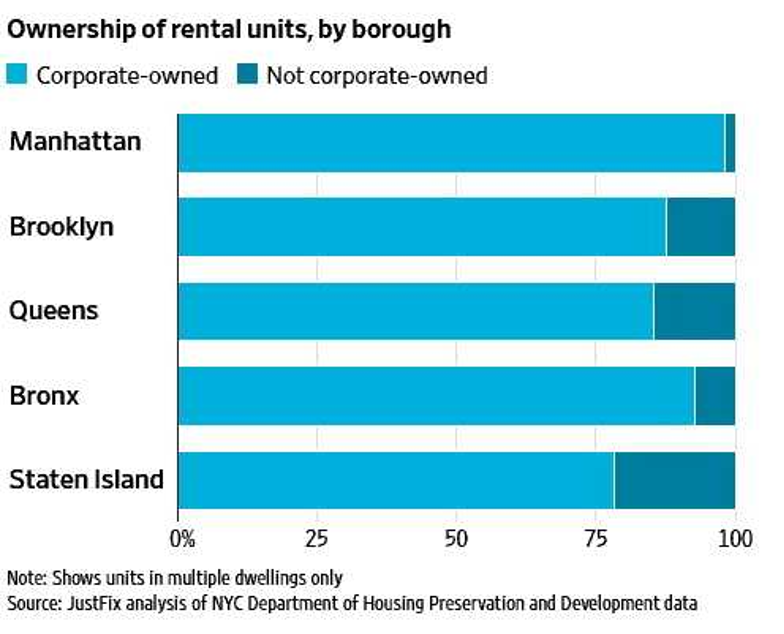
Ownership of rental units, by borough
Home Sellers Become Reluctant Landlords
With home sellers tired of watching their listings languish in a dreary
housing market, more of them are opting to take their chances by renting
out their homes. A near-record share of rental listings fall into this
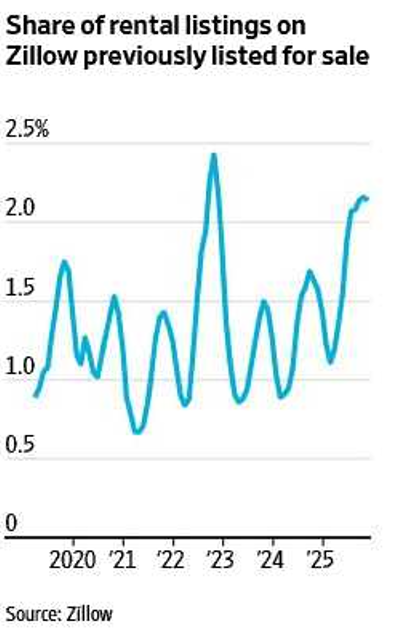
category of accidental landlord. About 2.2% of rental listings on Zillow in
November had previously been listed for sale. That’s the highest level
since late 2022 when mortgage rates surged above 7%.
It was even higher in markets where unsold listings are growing stale.
Houston had the highest rate of accidental landlords in December, at
4.2%, followed by Denver; Austin, Texas; and Tampa, Fla., Zillow said.
Selling a home usually means stepping aside and letting a real-estate
agent handle the process. But being a landlord often means getting
your hands dirty. It comes with financial risks, including damage to the
home, or disputes with tenants that many home sellers never imagined
they would encounter.
Share of rental listings on Zillow previously listed for Sale
Leases for Spas, Gyms Outstrip Retail
When Americans are out shopping these days, they are more likely to be
buying Botox or boxing lessons than shoes or shampoo.
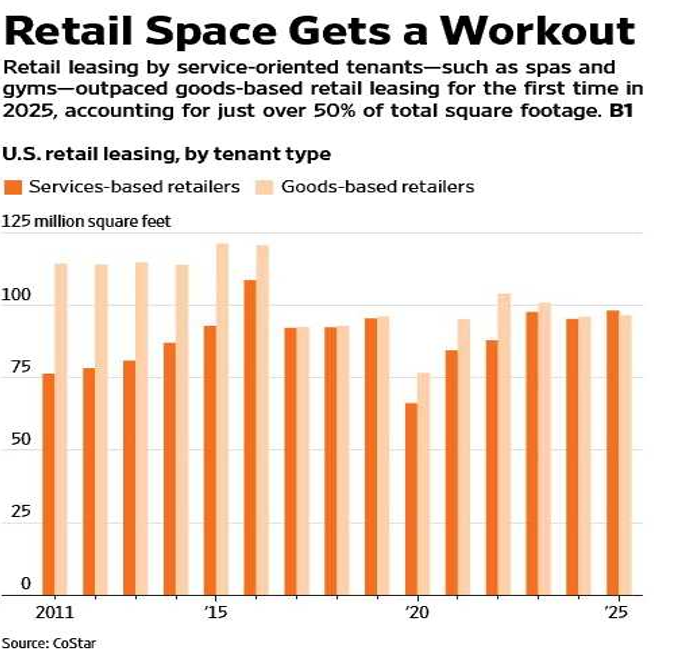
Retail leasing by service oriented tenants outpaced goods-based retail
leasing for the first time ever, a reversal driven in large part by a proliferation
of salons, spas and fitness studios.
Service-based tenants leased just over 50% of total retail square footage in
2025, according to data firm CoStar. Fifteen years ago, service tenants
accounted for only 40% of total leasing.
One of the fastest expanding operators nationwide is Planet Fitness, which
added more than a million members last year and plans to open nearly 200
new locations in 2026.
E-commerce sales accounted for 16.4% of total re–tail sales last year,
according to the U.S. Department of Commerce, compared with about 8% in
2016. And many apparel tenants are shrinking their stores’ footprints.
U.S. retail leasing, by tenant type
Pending Home Sales Climbed 1.8% In February,
Exceeding Expectations.
The number of homes going under contract in the U.S. rose in February,
according to a monthly index from NAR.
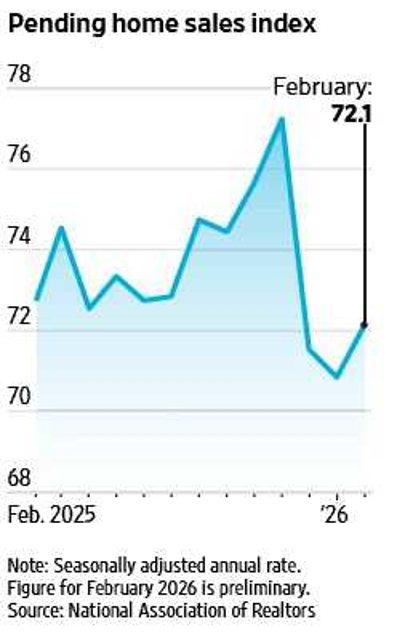
The pending home sales index, a leading indicator of house sales based
on contract signings, rose 1.8% on month to 72.1. Economists polled by
The Wall Street Journal had forecast a 0.6% decline.
“The slight gain in pending contracts appears to be driven by improved
affordability conditions,” said NAR Chief Economist Lawrence Yun.
“However, those conditions could reverse if higher oil prices lead to an
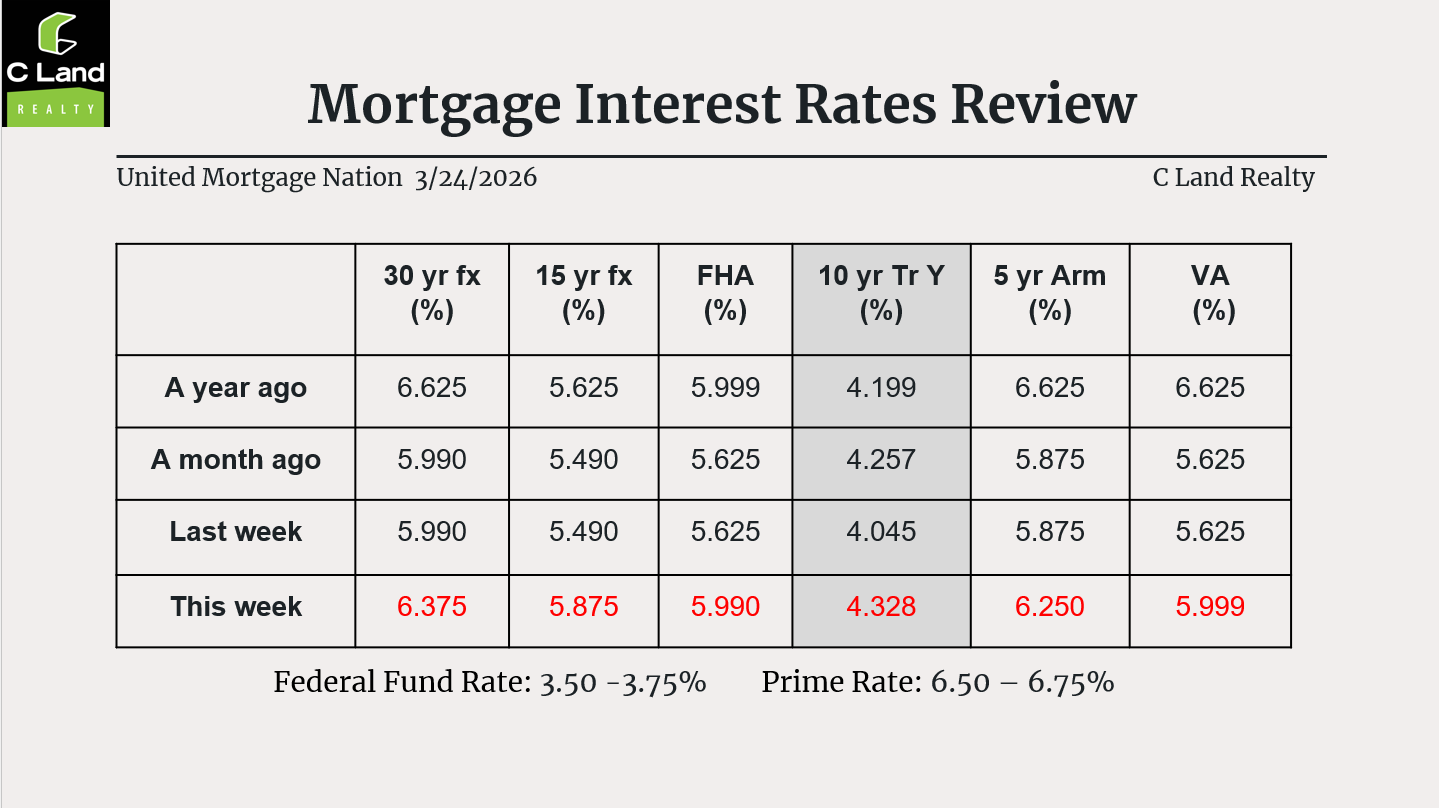
uptick in mortgage rates,” he added.
Over the month, pending home sales slipped 3.6% in the Northeast
region. Meanwhile, homes under contract rose 4.6% in the Midwest, 2.7%
in the South and 0.9% in the West.
Pending home sales index
Korean Won closes above 1,500 per Dollar.
Highest level in 17 years since the financial crisis. Dual shock of high oil
prices and high exchange rates becomes reality.
Dollar index also surpasses psychological threshold. Amid escalating
tensions in the Middle East that are evolving into an energy conflict, the
Korean won–U.S. dollar exchange rate has surpassed 1,500 won for the first
time in 17 years since the global financial crisis. The dual shock of rising oil
prices and a weakening currency is becoming a reality.
The dollar index, which measures the value of the U.S. dollar against six
major currencies, also rose to 100.28 as of 4 a.m. Eastern Time, once again
surpassing the psychological level of 100.
The sharp rise in the exchange rate was driven by growing instability in
Middle Eastern energy markets. Israel launched an airstrike on Iran’s gas
fields, raising concerns that Iran could retaliate against energy infrastructure
in the region, increasing fears of disruptions to oil supply.
Young Workers Find Ways To AI-Proof Their Careers.
Jackson Curtis planned to spend his career in insurance, where he has
worked for the past 3½ years. Instead, the 28-year-old is now pursuing
an abrupt shift: becoming a full-time firefighter. Some are pivoting to
bluecollar work or starting their own businesses that may insulate them
from the impacts of AI. Others are actively embracing it to try to take
advantage of an AI boom and stay ahead of the curve.
A recent Harvard University survey of Americans between ages 18 and
29 showed that 59% said they saw AI as a threat to their job prospects.
Other analysis has likewise found that in-person work tends to be more
insulated. A recent study by AI company Anthropic showed that
agriculture and construction jobs are less likely to be performed by AI,
while jobs such as computer programmers and customer-service reps
are more vulnerable. A Microsoft analysis last year drew similar conclusions.
Beijing’s Big Problem: A Shrinking Economy.
China’s economy has never been stronger. Its exporters have powered the
country to a $1.2 trillion surplus with the world. It is the global leader in
strategically important industries such as electric vehicles, solar panels,
shipbuilding and humanoid robots.
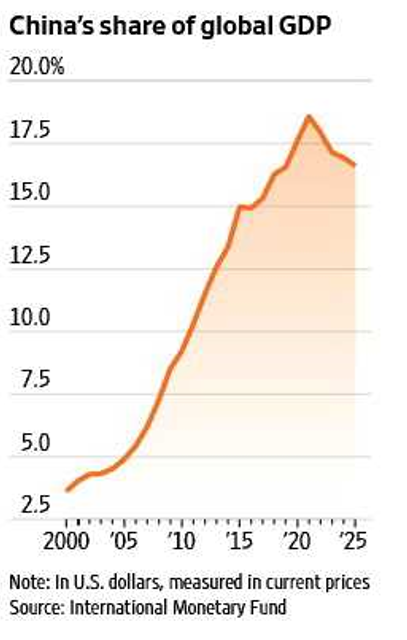
Yet, China’s global heft is shrinking. In dollar terms, China’s gross domestic
product, as a share of the global economy, peaked in 2021 at around 19%.
But, China’s share of the pie has decreased, ending 2025 at around 17% of
the global economy. It is now less than two-thirds the size of the U.S.
economy, according to IMF data.
Last month, the IMF wrote that China’s real exchange depreciation was
contributing to strong exports and said the government should promote
consumption at home. A separate IMF post noted that growth has been
“increasingly dependent on external demand.” Chinese exports surged 22%
in the first two months of the year.
China’s share of global GDP