

New Jersey Home Price Growth Ranks #1 in the Nation
• Compared to the national average home price growth of 0.5% during the same period,
home prices up 6% compared to last year Driven by influx from New York City and limited supply.
While the national housing market is generally slowing down, New Jersey’s home price growth has emerged as the most prominent in the country.
• The ‘Spillover’ Effect: The strongest factor is the high correlation with the New York City housing market.
• Commutability: Areas within commuting distance to New York are becoming increasingly preferred as residential alternatives.
• High-Income Jobs: New Jersey is home to a high concentration of finance, pharmaceutical, bio, and tech industries, ensuring a steady influx of buyers with high purchasing power.
• Supply Shortage: Simultaneously, limited housing supply is intensifying market competition. New Jersey’s current housing inventory is significantly lower than pre-pandemic levels
Housing Sales Decline as Key Spring Season Starts.
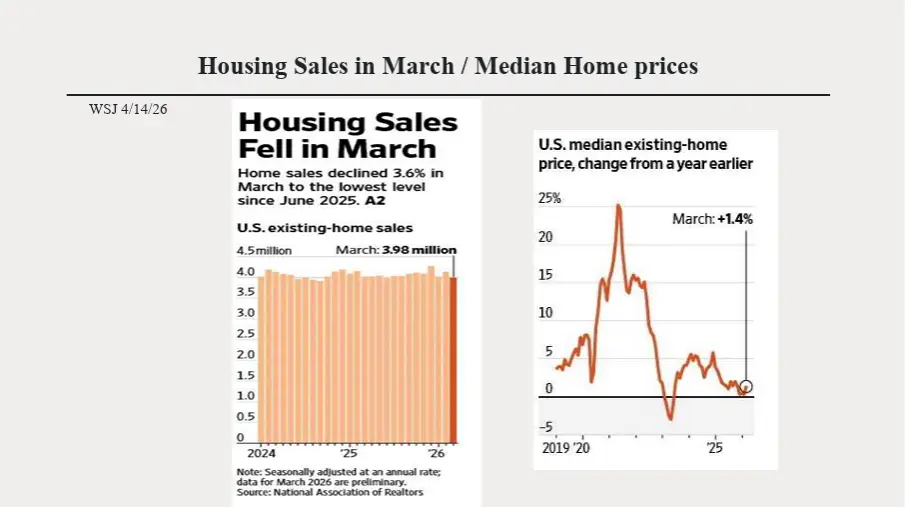
• Home sales declined 3.6% in March, getting the crucial spring selling season off to a poor start as the high cost of housing and economic uncertainty held buyers back.
• Sales of existing homes fell in March to a seasonally adjusted annual rate of 3.98 million,
the lowest level since June 2025, the National Association of Realtors said Monday.
• It was the second largest monthly decline in the past year. The housing market was stuck in a rut during the previous three years, and this year looks no better.
• Higher home prices reflect how national inventory remains below pre-pandemic levels, though supply is rising.
The number of homes for sale rose 3% from February and rose 2.3% from March 2025, NAR said.
Repair Costs for Aging Homes Are Going Through the Roof.
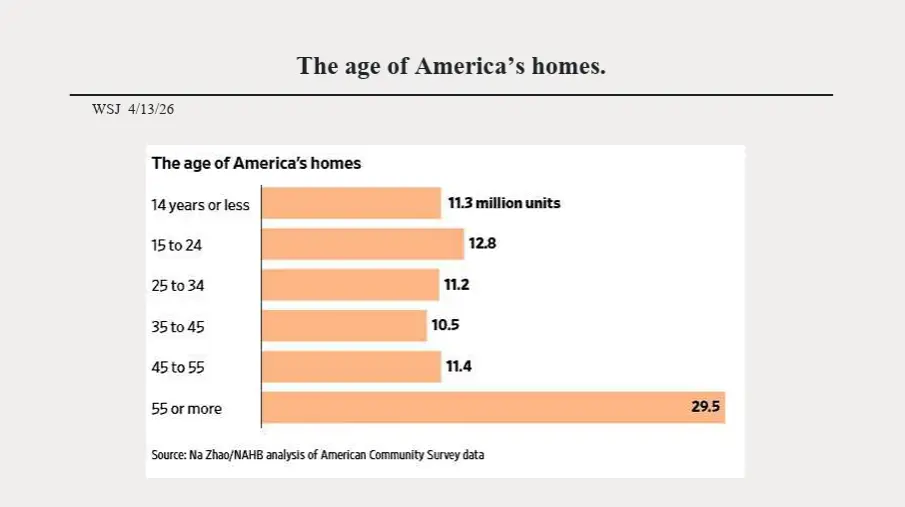
• A home-construction boom sprouted across America in the roaring 1920s.
Millions more single-family units went up across suburbia after World War II.
Building surged again in the 1970s.
• Now those homes are old. More recent new construction hasn’t replaced America’s graying housing stock,
meaning the age of the median home is a record 44 years,
according to the Harvard Joint Center for Housing Studies.
• The typical house is well past the age when the roof needs repairs and the furnace needs replacing.
The extent of maintenance and modernization needs is vast, and the cost of doing it is going up fast.
• In 2023, homeowners in the U.S. spent an average of $9,030 on replacement projects such as windows,
up 59% from 2009 after adjusting for inflation, said Harvard’s Drew.
1 in 3 people “want a housing market Collapse”.
Renters: “If house prices crash, it’s my chance to own a home.”
Homeowners: “Reduced property tax burden; hope for structural change.”
Outlook: Price increase forecasts still dominate… positive response to 50-year mortgages.
• According to a recent survey by the financial information site LendingTree,
31% of respondents—nearly 1 in 3—stated they want to see the housing market collapse.
The survey was conducted among 1,203 homeowners and 797 non-homeowners.
Broader Perspectives
Market Stability: Some respondents (33% of homeowners, 26% of renters) believe
a “collapse” is necessary to restore long-term stability to the market structure.
Economic Reform: Some see it as a catalyst for overall economic reform, likely influenced by the memory of how prices
corrected after the 2008 global financial crisis.
50-Year Mortgages : About 30% of renters and 29% of homeowners expressed interest in using such a long-term loan to reduce costs.
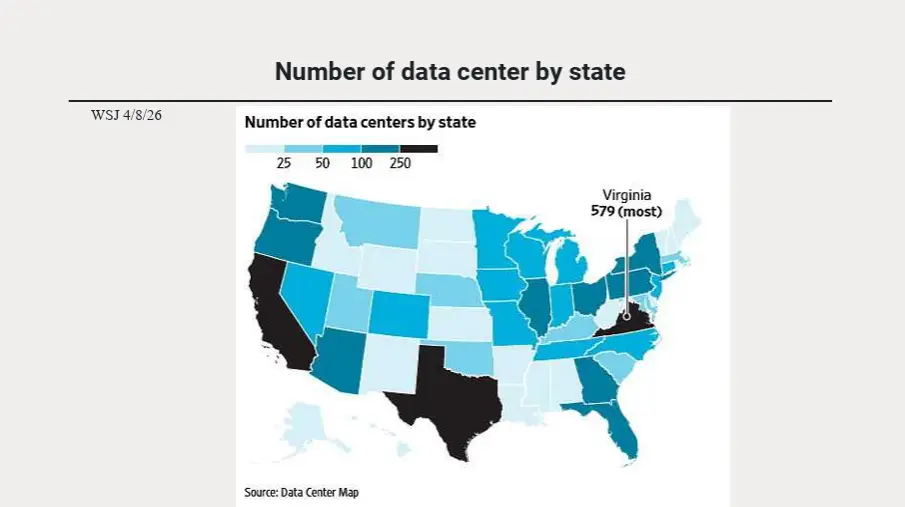
The Locations Taking Aim at Data Centers.
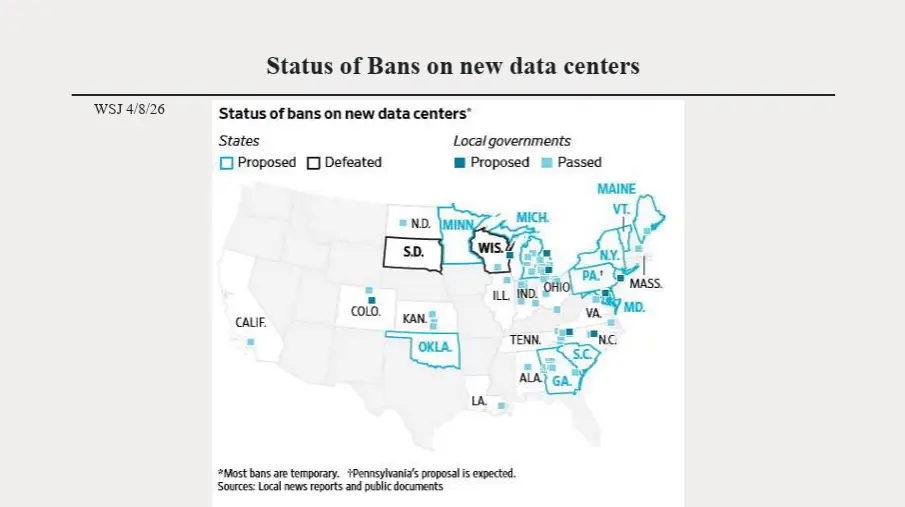
• Maine looks poised to become the first state to freeze building of new data centers with legislation that could pass this spring,
but community backlash against these properties is spreading across the country.
Lawmakers in Virginia and Texas lead the country in data-center construction,
with 579 and 411 server farms,
respectively, according to the industry website Data Center Map.
The more than 10 states have proposed temporary bans on data-center construction this year.
Dozens of county and city governments have already passed such measures.
• Data-center boom today is driven by the construction of large properties for training and operating artificial intelligence,
or so-called hyperscale data centers.
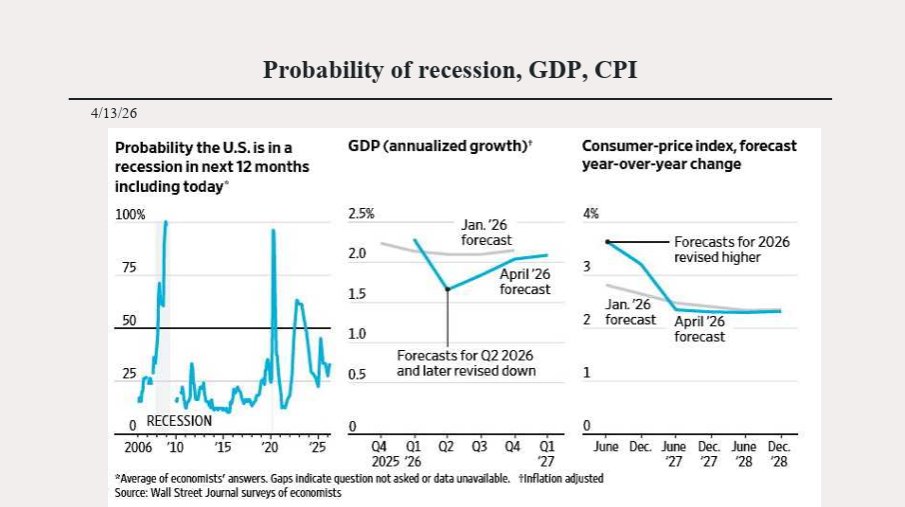
Views Dim on Growth, Inflation and Jobs.
• Recent months have been marked by slower growth, stubborn inflation and a weaker job market.
Economists worry that the war in Iran could exacerbate all three. With hostilities paused by a tenuous cease-fire last week,
he path ahead for the war itself is highly uncertain— let alone its consequences for American workers and shoppers.
But a group of economists regularly surveyed by
The Wall Street Journal has broadly dimmed its outlook for the year ahead, compared with their expectations earlier this year.
• “For now, the data is still telling us that we should be very reluctant to assume a large decline in growth,”
said James Egelhof, chief U.S. economist at BNP Paribas. “Inflation is rising with no clear end in sight.”
• “The main risk is that consumers, who have been supporting the economy despite all other shocks over the past year,
will finally be strangled,” said University of Michigan economist Daniil Manaenkov.
U.S. Looks to Boost Its Fleet of Noncombat Ships.
• The Trump administration is pushing for the biggest upgrade
in decades to the nation’s fleet of noncombat ships in a bid to boost U.S. shipbuilding and strengthen
America’s ability to prosecute wars overseas.
• Agencies from the U.S. Navy to the National Science Foundation are requesting funds in the 2027 fiscal year budget for cargo ships,
vehicle carriers, cutters and a research vessel.
Even the National Park Service is asking for a ferry.
• Most of the requested vessels would expand the number of noncombat ships
the U.S. can turn to in wartime to carry ammunition,
cargo and vehicles and to refuel and rearm warships at sea.
Others, such as an Antarctic research vessel for the National Science Foundation, could serve geopolitical goals.
• The Navy is requesting a 46% increase over last year’s shipbuilding budget to $65.8 billion




Join The Discussion