

Broker Fees Hinder Residential Mobility
• Federal Appeals Court Dismisses Lawsuit Against FARE Act. Ordinance Banning Shift of Broker Fees to Tenants Maintained.
• On the 13th, the U.S. Court of Appeals for the Second Circuit dismissed the plaintiffs’ claims
in a lawsuit filed by New York City landlords and real estate brokerage groups opposing an ordinance
(the FARE Act) that prohibits forcing tenants to pay broker fees.
• The FARE Act, which took effect in June 2025, mandates that landlords pay real estate broker fees to the agents they hire.
James Whelan, president of REBNY, stated,
“We are disappointed by the appeals court’s decision and will continue our legal challenge,”
while criticizing that
“the FARE Act hinders housing accessibility and transparency for New Yorkers while simultaneously causing rents to continue to rise.”
Downsize? No Thanks. Boomers Buy Bigger Homes.
• Well-off boomers are increasingly upsizing their homes as they age, either buying bigger ones or financing additions to their existing properties.
They are building guesthouses for family members and gourmet kitchens for entertaining,
alongside such features as high-end grab bars and first-floor primary bedrooms for aging in place.
• In the process, they are rewriting the rules of retirement and aging, when people are expected to move into smaller homes to save money.
• This year, eight of the clients of Merrill Lynch financial adviser April Tardiff retired.
Every single one of them upsized.
Only one client has downsized in the past five years.
• Other factors keep boomers from downsizing.
Many want to avoid paying large capital gains taxes on the sale of a long-held home that has appreciated a lot in value.
Others are finding the housing stock of smaller homes is minimal, and relatively expensive
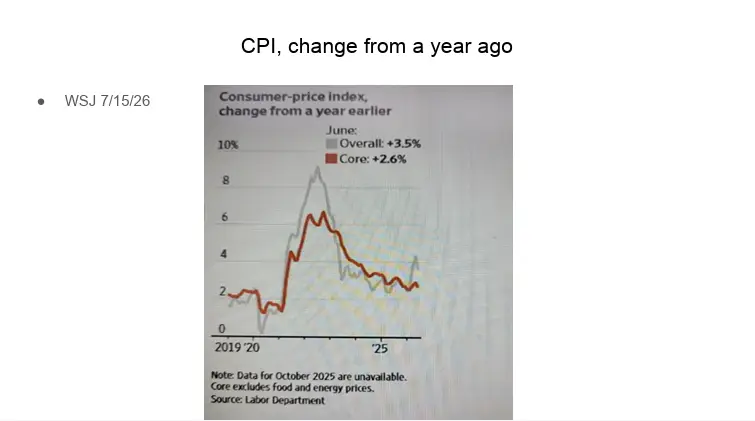
Inflation In June Slowed To 3.5% As Oil Fell
• U.S. inflation cooled to 3.5% in June as gas prices declined after President Trump reached a ceasefire agreement with Iran,
but renewed fighting in recent days has revived the risks the conflict poses to the nation’s economy.
• The increase in consumer prices last month from a year earlier was smaller
than expected and marked an improvement from the 4.2% inflation in May.
June inflation was also lower than the 3.8% that analysts polled by The Wall Street Journal expected.
• Price slowdowns were broad-based. Prices fell in June from May for apparel, used cars,
car insurance and medical care. Shelter costs registered their smallest month-over-month increase since 2021.
• On Tuesday in his first appearance on Capitol Hill since his April confirmation hearing,
Warsh said that cooler June inflation doesn’t mean the Fed can declare mission accomplished.
Chinese AI Models Raise Alarm in U.S.
• Silicon Valley and Washington are debating a multibillion-dollar question: Should U.S. companies be able to use Chinese artificial-intelligence models?
• OpenAI and Anthropic executives are sounding the alarm about the rise of cheap AI, particularly powerful new models produced in China,
suggesting they will lead to a “dystopian” AI future and present unacceptable security risks without regulation.
• The emergence of highly capable, open autonomous AI systems—including Moonshot AI’s Kimi K3 model and Alibaba’s Qwen 3.8 Max,
which were released in recent days and viewed favorably by investors and users—has turned the AI race on its head once again.
Kimi K3 also was competitive with U.S. models on some benchmarks.
• “One probable outcome of an open-weight-model-dominant world is full AI communism,
which is precisely what China proposes: rather than a market product, AI is a ‘public good’
which will ultimately be provided by the state as a kind of ‘digital public infrastructure,’”
Dean Ball, OpenAI’s head of strategic futures, said in an X post Friday.
IBM’s Shocking Profit Warning Comes Amid an AI Reckoning
• IBM’s board was staring down difficult news: The second quarter had been a bust.
• Directors had long known that the artificial-intelligence revolution would upend the technology icon’s business,
but the pain came sooner than expected, leaving the company with a tough choice.
• Board members debated whether to issue a rare warning that bad news was coming or wait for the numbers to hit the tape
a week later when executives could discuss them with investors, the people said.
• Board members are aware that the near-term is likely to be messy and that an impatient
Wall Street is unlikely to tolerate two or three more quarters of underperformance,
according to the people familiar with the board discussions.
Korean Auto Workers Strike Over Robot
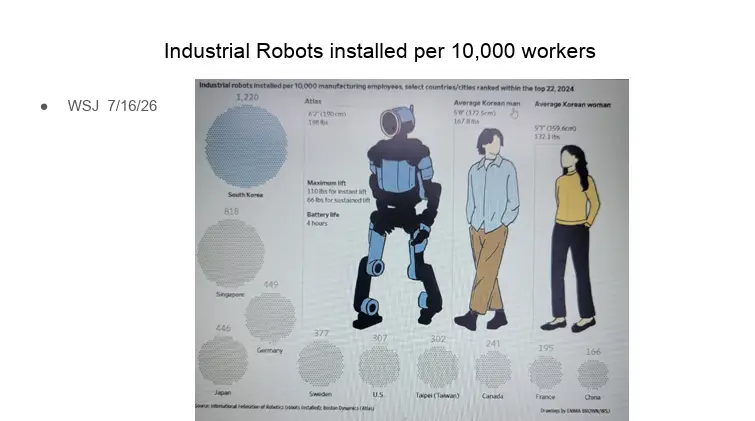
• Hyundai Motor unveiled its humanoid robot worker named “Atlas” in January,
tens of thousands of Korean auto employees gaped at the 6-foot-2 robot strutting across a tradeshow stage,
its joints swiveling a full 360 degrees.
• The union’s response was blunt: Atlas would never step onto a production line without workers agreeing first.
This week, Hyundai’s auto workers in South Korea have gone on a partial strike.
It is the car industry’s first factory stoppage addressing humanoid robots.
• Tesla expects production for its Optimus humanoid robots to start by year’s end.
German auto-parts maker Schaeffler is using fourfingered robots in South Carolina.
China’s Xiaomi earlier this year started a trial run of humanoid robots in its EV plants.
BMW began testing out the “Aeon” robot in Germany for the first time last month.
General Motors recently added dozens of “cobots”.




Join The Discussion