

Why are NJ home prices keeping up ?
* Opening
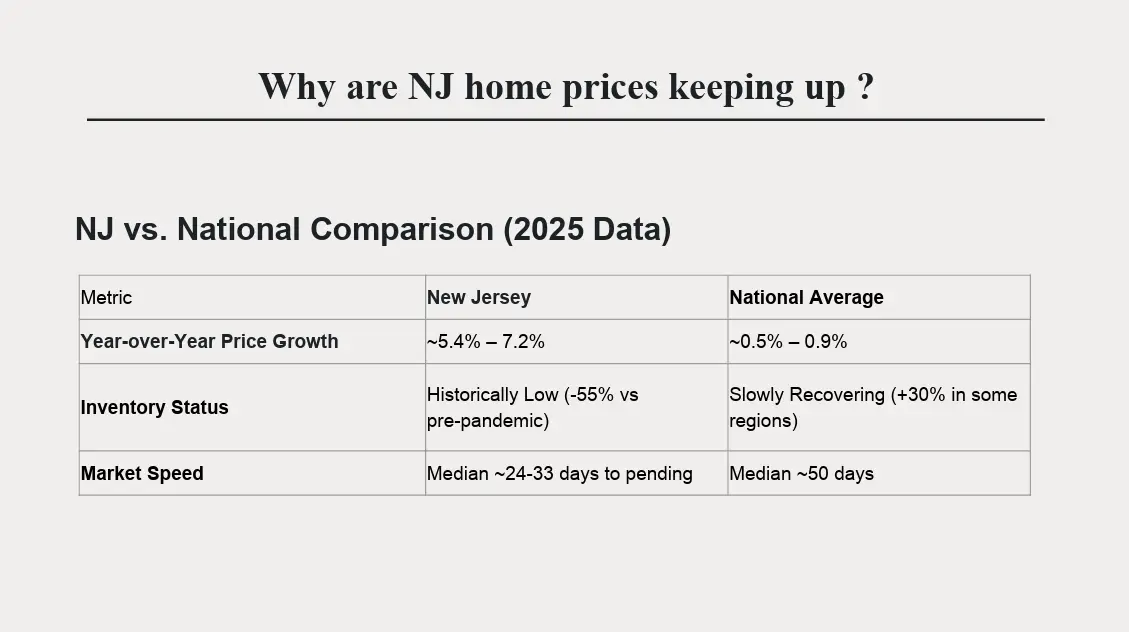
● New Jersey’s real estate market has significantly outperformed the national average over the last year,
with prices rising approximately 5.4% to 7% while the national growth stalled at roughly 0.9%.
● This “NJ anomaly” is driven by a unique combination of extreme supply shortages and persistent demand from high-wage commuters.
Here is an analysis of the primary reasons for this trend:
1.Severe Inventory Crisis (The “Supply Gap”)
● New Jersey currently has one of the most significant housing supply gaps in the country.
● Months of Supply: A “balanced” market typically has 6 months of inventory.
NJ has hovered around 3.2 months, and in high-demand areas like Bergen County, it has dropped as low as 1.4 months.
● The “Lock-in” Effect: Many NJ homeowners have mortgage rates around 3-4%.
They are unwilling to sell and trade those for current rates (often 6.5%+), which has paralyzed the “move-up” market.
● Construction Lag: The Northeast generally lags behind the South and West in new housing starts.
High regulatory costs and a lack of developable land make it difficult to add new supply quickly.
2. The “Manhattan Exodus” and Hybrid Work
● The shift toward hybrid work has permanently increased the value of NJ’s commuter towns.
● Relative Value: While NJ prices seem high, the median home price is still only about 65% of New York City’s.
Professionals in finance, pharma, and biotech are choosing NJ to get more space without sacrificing access to high-paying jobs.
● Transit Access: Areas with “Midtown Direct” train access or easy highway commutes to NYC (like Montclair, Ridgewood, and Summit)
have seen the most aggressive bidding wars, with nearly 40% of homes selling above asking price.
3. Geographic Resilience & Quality Schools
● Unlike “boom-and-bust” markets in the Sun Belt (like parts of Florida or Texas)
that saw massive price corrections after the pandemic, New Jersey’s market is anchored by:
● Top-Tier Education: Properties in high-quality school districts (e.g., Princeton, Millburn) maintain
a vacancy rate of less than 3% and act as a safe haven for capital,
keeping prices buoyant even during high-interest-rate periods.
● High Household Income: NJ consistently ranks as one of the wealthiest states.
This high median income provides a “floor” for prices,
as there is still a large pool of buyers capable of absorbing higher costs and mortgage rates.
Summary
● While the rest of the U.S. is seeing a “rebalancing” due to high interest rates, New Jersey remains a seller’s market.
The national average is being dragged down by corrections in the South and West where inventory has flooded the market.
In contrast, NJ’s combination of limited land, high wages, and proximity to NYC creates a persistent
“Economic Iron Curtain” that keeps prices climbing.




Join The Discussion