

Housing Market’s New Test: The 7% Mortgage
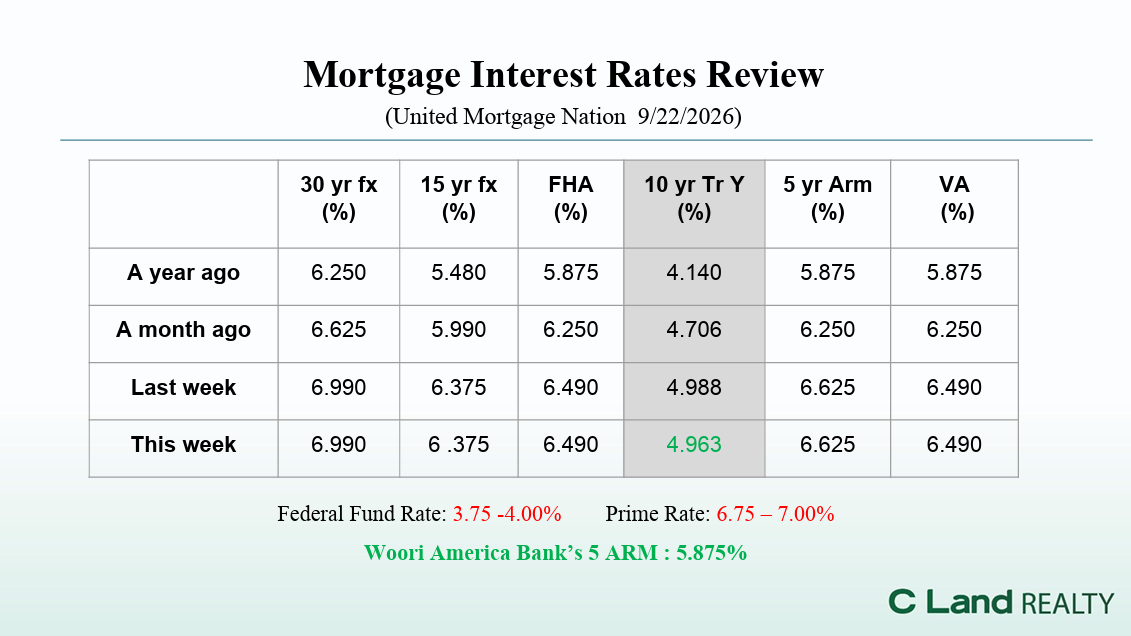
• Last week, 30-year fixed rates averaged 6.76% according to Freddie Mac.
But daily rates have jumped since then and already surpassed 7%, according to Mortgage News Daily, which uses a different methodology.
• Mortgage rates as surveyed by Freddie Mac touched 7% in January 2025,
but they haven’t stayed above that level for an extended period since the second half of 2023.
Before 2022, mortgage rates hadn’t hit 7% since 2001.
• The rate on a 30-year mortgage tends to follow the 10year Treasury yield,
which on Tuesday rose as high as 5.04%, its highest level since 2007, before settling just below the 5% level.
• Now, inventory is near pre-pandemic levels because homeowners,
getting impatient waiting for rates to fall, have decided to sell anyway.
But 7% mortgage rates could hurt that progress.
Housing Starts Pulled Back In August
•Housing starts, a gauge of new residential construction, fell 2.6% in August to
1.275 million, the Commerce Department reported on Thursday.
•Starts were down 1.2% in August from the same month of 2025.
•Residential permits, another measure of trends in housing construction, weredown 2.7% at 1.394 million in August.
Economists polled by The Wall Street Journal had expected a reading of 1.4 million.
•On Wednesday, the National Association of Home Builders reported builder
sentiment fell to its lowest level in a year, suggesting further weakness could
be ahead in September’s housing starts.
•“The big picture remains that elevated and rising borrowing costs are holding
developers back, supporting our view that the downward trend in housing
starts has further to run,” a note from Capital Economics says.
Fed Delivers First Rate Hike in 3 Years
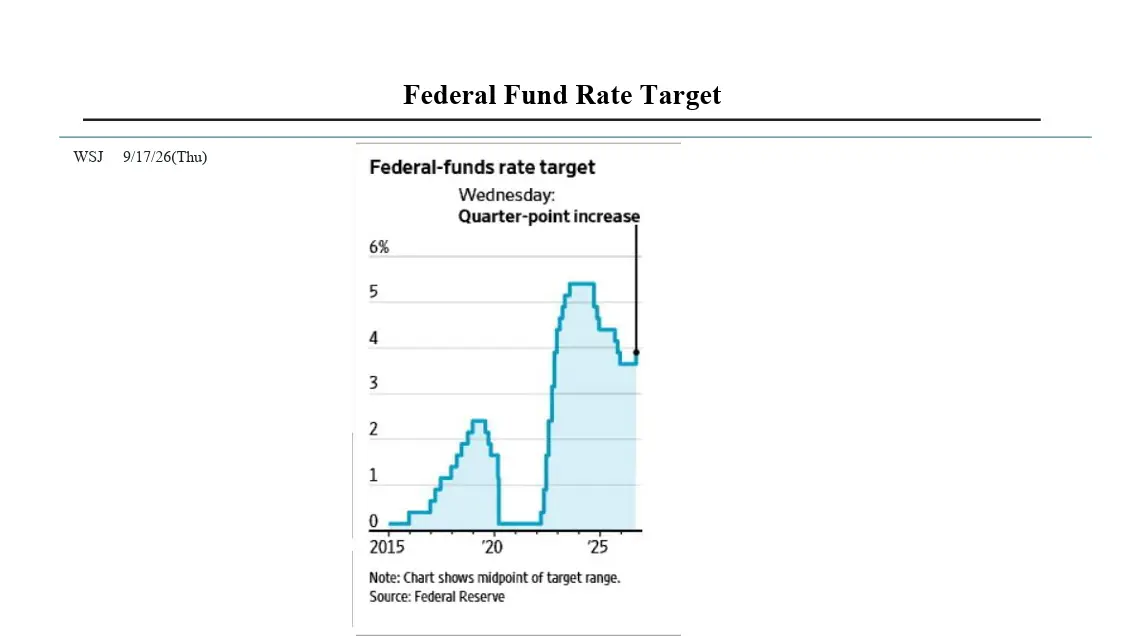
•The Federal Reserve raised interest rates Wednesday for the first time in
three years, a sharp reversal that began taking back cuts it made last year and
implicitly undercut the White House’s insistence that inflation isn’t a concern.
•The increase, approved unanimously, will raise the benchmark federal-funds
rate range by a quarter point to between 3.75% and 4%. The vast majority of
officials penciled in one more increase this year in interest-rate projections released after their meeting.
•The 30-year mortgage rate climbed to nearly 7% last week, the highest in
nearly a year, according to a survey by the Mortgage Bankers Association
released Wednesday. It stood at 6% in February, before the U.S. campaign in Iran began.
How Rate Rise Hits Borrowing, Savings
• Consumer debt : Credit-card borrowers will feel the increase quickly. A quarter-point
hike would add about $1.38 a month in interest on the average $6,600 card balance.
• Mortgage rates: Mortgage rates are tied to the 10-year Treasury yield rather than the
shorter-term federal funds rate set by the Fed.
• Other home debt: The federal funds rate has a more immediate impact on interest
rates for short-term debt, including home equity lines of credit
• New-home market: The largest homebuilding companies tend to generate financing
through the corporate bond market, where rates, like mortgage rates, are more
dependent on long-term Treasury yields than the federal funds rate.
But smaller builders and flippers rely on short-term construction financing that is heavily influenced by Fed
rate hikes. That could make it more challenging for projects to pencil out, at a time in
which the U.S. housing market desperately needs supply.
• Savings accounts: The quarter-point increase should push savings rates higher, especially atonline banks.
High-yield accounts could begin repricing within days or weeks.
Young Adults Flee ‘Expensive Major Cities’
In particular, Gen Z prefers areas with plentiful job opportunities, while
Millennials tend to favor regions where they can secure spacious yet affordable housing.
According to Redfin, the top destination with the highest net inflow of Gen Z
residents was San Antonio, Texas, with 10,678 more people moving in than leaving.
Washington D.C. came in second at 8,631 residents, followed by
Austin (8,590), Nashville (8,093), Dallas (6,944), Providence, Las Vegas,
Virginia Beach, Honolulu, and Houston among the top 10 choices.
The city with the largest net outflow of Gen Z was New York, with 29,554, and
Minneapolis followed closely behind with 10,781, while Los Angeles had 10,646 more people leaving than arriving.
Denver and Detroit also recorded net outflows of 10,382 and 11,696 residents, respectively.
For Millenium, Houston ranked #1 for net Millennial inflow, with 16,365 more people moving in than out.
Dallas followed with 13,072, Baltimore with 11,724, Las Vegas with 8,860, and Atlanta with 8,753.
Economies Hum Despite Higher Rates
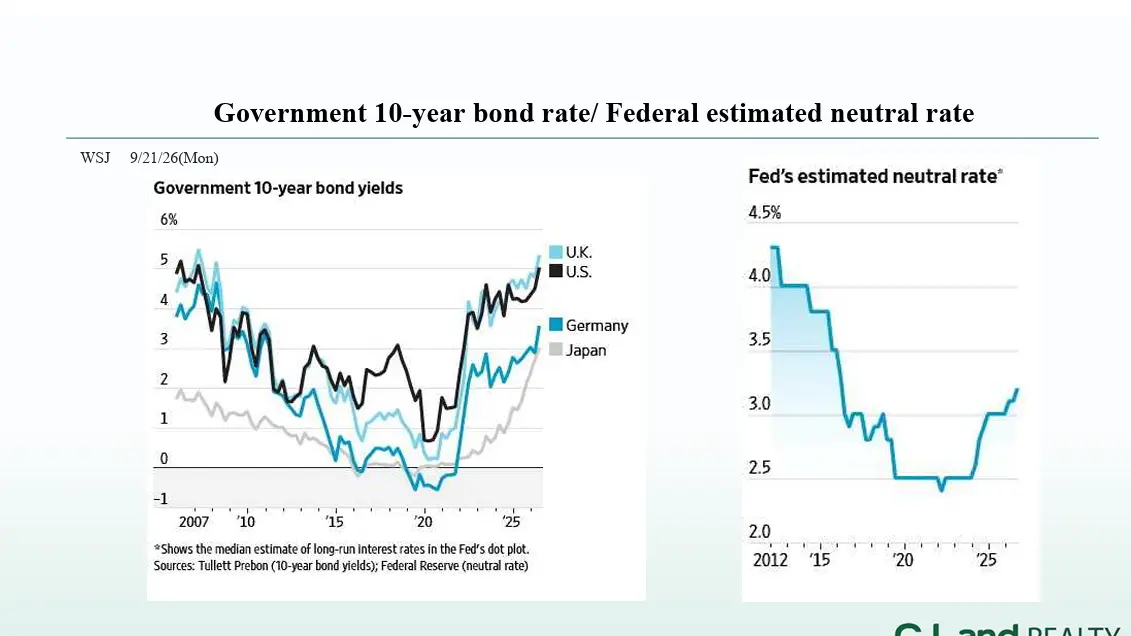
Economies around the world are showing surprising resilience to higher
central bank-interest rates and government bond yields that have jumped to
multidecade highs across the developed world.
The Federal Reserve, Bank of Japan and European Central Bank are among central banks that have lifted
interest rates to contain inflation driven by the war with Iran.
Investors expect they will not only keep tightening policy, but hold rates at
higher levels for the foreseeable future. The economy’s strength in the face of
higher borrowing costs suggests it has shifted into a higher gear,
helped by a surge in AI investment that economists hope will boost productivity for years to come.
Economists are raising estimates for a key indicator known as the neutral rate
of interest—an elusive level where borrowing costs neither restrict nor stimulate growth.
Neutral rates are often described as a guiding light for
central bankers, though policymakers say they don’t directly target them.
AI’s Threat to China’s Control
The arrival of the internet led many in the West to predict the fall of Chinese communism as the torrents
of free content on the global web undermined the party’s control of information and empowered individuals.
China’s rulers solved that issue with some continuing problems.
The so-called Great Firewall cut most Chinese users off from the open internet,
and a combination of close censorship and heightened surveillance dramatically reduced Chinese
citizens’ ability to use the web as a tool for political dissidence.
But keeping Chinese AI inside the Great Firewall may not be easy.
Good AI isn’t a respecter of human taboos.
The body of doctrine Chinese media refers to as Xi Jinping Thought on Socialism with Chinese Characteristics for a New
Era may be essential reading for party officials, but this is exactly the kind of conceptual prejudice that AI agents are built to transcend.




Join The Discussion