
Affordability Strategies (The “High Rate” Offset)
Navigating the current high-interest-rate environment requires moving beyond standard mortgage products and focusing on structural financial strategies that directly address monthly affordability.
Here are the primary options and strategies currently available for your buyers in this market, broken down by loan type, affordability tools, and specialized programs.
In a high-rate environment, the most effective strategy is often utilizing seller concessions rather than price reductions.
Affordability Strategies (The “High Rate” Offset)
Temporary Rate Buydowns:
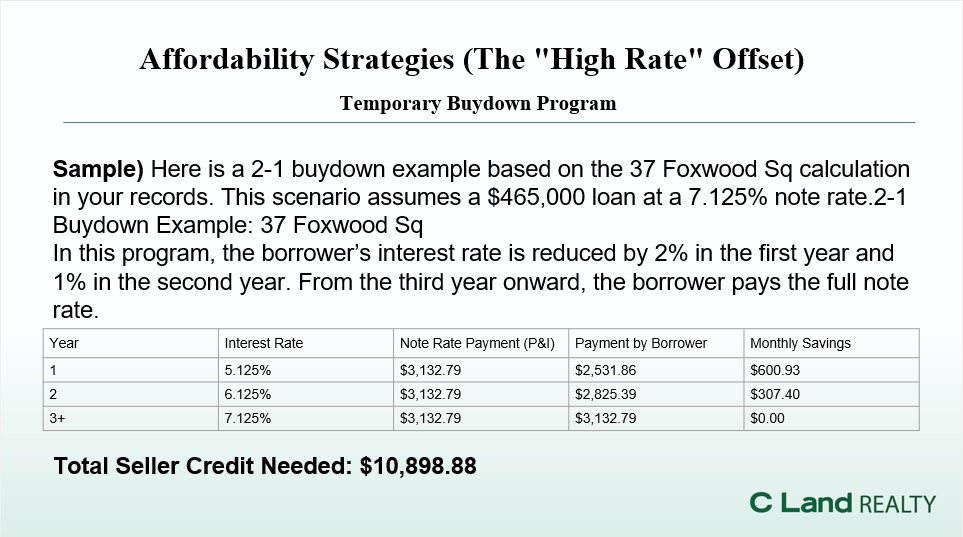
This is arguably your strongest tool. A seller can offer credits (often called a 2-1 buydown) to temporarily lower the buyer’s interest rate for the first 12–24 months.
Why it works: Research indicates that a $15,000 seller credit applied to a rate buydown can reduce a buyer’s monthly payment significantly more than a $15,000 price reduction.
Affordability Strategies (The “High Rate” Offset)
How it works: The cost of the buydown is equal to the sum of the payment savings for the first two years ($600.93 × 12 months + $307.40 × 12 months). This total amount is deposited into an escrow account at closing by the seller or builder.
The Benefit: It lowers the monthly payment during the early years of , homeownership, providing “prepaid relief” that can help a buyer adjust to their new mortgage payment or preserve cash.
The “Seller Credit” Strategy: As this example demonstrates, a 2-1 buydown is often more effective than a price reduction for immediate buyer affordability. Instead of asking for a price drop, you can ask for a seller credit to fund this escrow account.
Affordability Strategies (The “High Rate” Offset)
2. Seller Concessions:
Beyond buydowns, sellers can contribute toward closing costs, which helps buyers preserve their liquid cash for an emergency fund or points to buy down the rate permanently. (The sale of 2700 Kennedy Blvd #302 (June 2026).Case Study: 2700 Kennedy Blvd #302, listed at $335,000)
1) Direct Seller Credit
Initial Request: The buyer proposed an offer with a $5,000 credit toward closing costs. The seller countered by declining the $5,000 request so that Final Agreed Outcome is the parties negotiated and settled on a total credit cap of $3,000.
Flexibility in Application: To ensure the deal could move forward, the credit was
structured to be applied flexibly toward any combination of:
Inspection-related items / Appraisal-related issues / General buyer closing costs at closing
Affordability Strategies (The “High Rate” Offset)
2) Pricing-in a concession
In this scenario, if a home is listed at $335,000 and the buyer needs $5,000 for closing costs, the purchase agreement is drafted at $340,000 with a $5,000 seller credit. The net result for the seller is still $335,000, but the loan amount is based on the $340,000 purchase price. Risks are considered:
The Appraisal Hurdle (Highest Risk): The property must appraise for the inflated purchase price ($340,000 in the example). If the appraiser determines the property value is only $335,000, the lender will only write the loan based on the appraised value. This creates a “gap” that either the buyer must cover in cash, or the seller must drop the price, effectively neutralizing your strategy.
Affordability Strategies (The “High Rate” Offset)
Lender Concession Caps: Lenders have strict limits on the total seller concessions allowed, typically based on the loan-to-value (LTV) ratio (often 3%–6%). If your inflated price plus the credit exceeds the lender’s allowable percentage of the sales price, the credit will be denied, or the loan will be rejected.
Transparency & Ethics: This must be fully disclosed in the contract and to all parties, including the lender. Attempting to “hide” this credit or inflate the price without justification can be flagged as mortgage fraud.
Affordability Strategies (The “High Rate” Offset)
3. Buying Discount Points
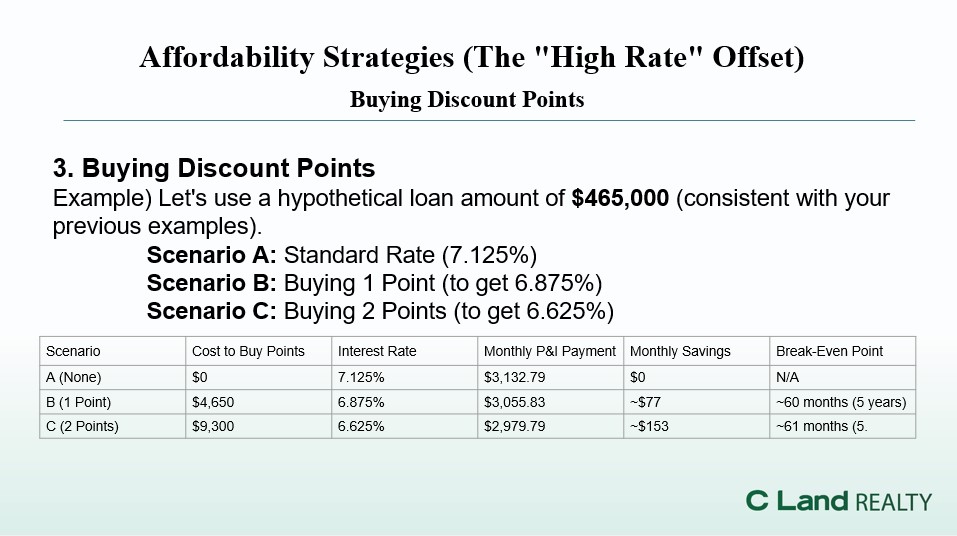
Buying discount points (often called “buying down the rate”) is a strategy where a borrower pays an upfront fee to the lender in exchange for a lower interest rate for the entire life of the loan. Unlike a temporary buydown, which expires after 1–2 years, permanent points reduce the interest rate for the full 30-year term.
Generally, 1 point equals 1% of the total loan amount. Buying 1 point typically lowers your interest rate by approximately 0.25% (25 basis points).
Affordability Strategies (The “High Rate” Offset)
3. Buying Discount Points
The “Break-Even” Analysis: This is the most critical metric. You calculate it by dividing the Total Cost of Points by the Monthly Savings.
In Example B: $4,650 / $77 = ~60 months.
Takeaway: If the buyer plans to move or refinance within 5 years, paying for points is essentially “wasting” money. If they plan to stay for 10+ years, the savings become significant.
Seller-Paid Points: In a buyer’s market, you can negotiate for the seller to pay for the points as part of a closing cost concession. This is often an easier sell to a seller than a price reduction because it keeps the final “Sold” price higher while solving the buyer’s long-term affordability issue.
Affordability Strategies (The “High Rate” Offset)
3. Buying Discount Points
Points vs. Temporary Buydowns:
** Use Points if: The buyer is buying their “forever home” and is highly confident
they will not refinance or sell for 5–7+ years.
** Use Temporary Buydowns if: The buyer is short on cash, needs immediate
monthly relief, or expects to refinance as soon as market rates drop in the next
1–2 years.



Join The Discussion