

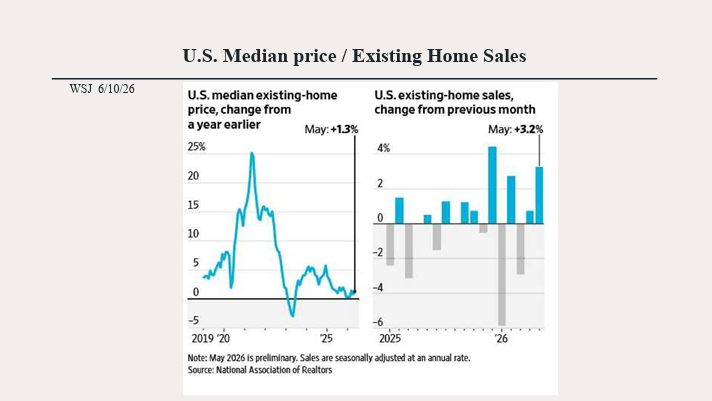
Existing Home Sales Reach Highest Level in Five Months
• Existing home sales across the United States rose more than expected in May,
signaling a potential improvement in the housing market.
• The National Association of Realtors (NAR) reported that existing home sales reached an annualized rate of 4.17 million units in May,
adjusted for seasonal factors, representing a 3.2% increase from April.
• The sales pace was the strongest since December of last year and exceeded economists’ expectations of 4.05 million units.
• Lawrence Yun, Chief Economist of the NAR, stated:
“More consumers are entering the housing market, resulting in the highest level of home sales since December.
This is encouraging news for the housing sector.“
• Overall, the latest data suggest that the U.S. housing market may be showing signs of gradual recovery,
supported by stronger consumer participation and improving market conditions.
U.S. Consumer Prices Rise 4.2% in May,
Highest Annual Increase in Over Three Years .
• Inflationary pressure expands amid the Iran conflict and rising oil prices. Gasoline prices up 7% from the previous month.
Core inflation (excluding energy and food) reaches 2.9%. Markets increasingly price in additional Fed rate hikes this year.
• The U.S. Consumer Price Index (CPI) rose 4.2% in May compared with a year earlier, marking the highest inflation rate in more than three years.
• As a result, financial markets have once again become concerned about persistent inflation.
Expectations for Fed interest-rate cuts have largely disappeared, while the possibility of further rate hikes later this year has gained traction.
• Meanwhile, core CPI, which excludes food and energy prices, rose 2.9% year-over-year and 0.2% month-over-month, slightly faster than expected.
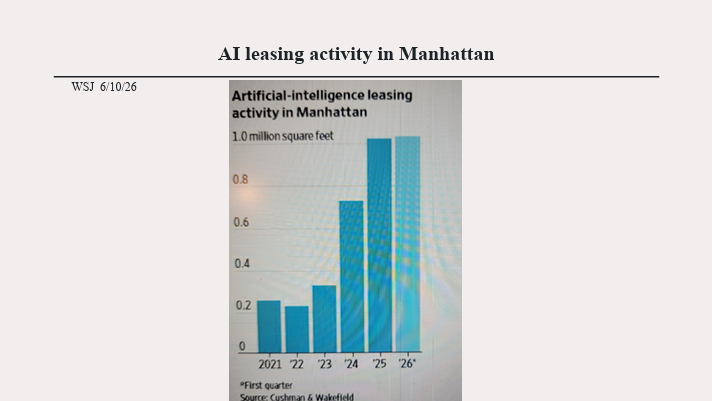
Manhattan AI Office Boom Echoes 2000.
• The hot Manhattan office market is on pace this year for its best leasing performance since 2000.
Back then, dotcom startups helped fuel demand. This time around, it’s AI.
• AI firms leased 1 million square feet of Manhattan office space in the first quarter.
That was greater than the space leased by AI firms for all of 2025. AI’s share of tech-sector leasing in Manhattan also jumped to 56% that quarter,
which was more than double AI’s share during all of 2024, according to Cushman & Wakefield.
• San Francisco is benefiting the most from AI. Companies in that sector accounted for 58% of leasing activity there in the first quarter,
helped by Anthropic’s lease of more than 400,000 square feet, according to real-estate firm CBRE .
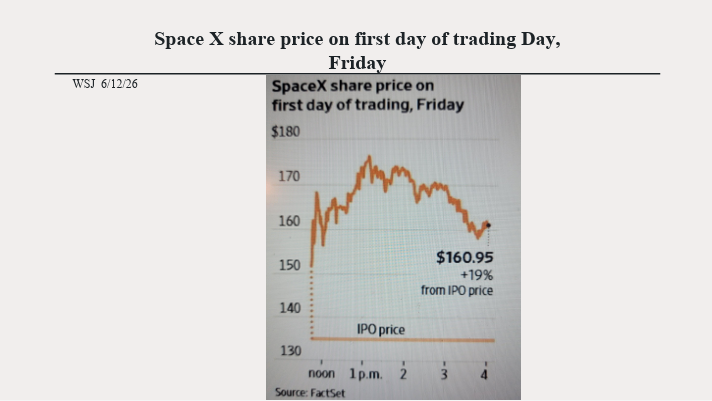
SpaceX Soars in Record Debut.
• Largest initial public offering in history mints Musk as the world’s first trillionaire in blockbuster day on Wall Street.
• Shares in SpaceX soared 19% Friday as Elon Musk’s rocket-maker pulled off the largest initial public offering ever and turned Musk into the world’s first trillionaire.
• The company, valued at $1.77 trillion when it sold $75 billion worth of shares a day earlier,
ended its first day of trading with a market value of $2.1 trillion,
putting it ahead of Broadcom and Tesla to make it the sixth most valuable public company in the U.S.
• SpaceX lost $4.9 billion last year on revenue of $18.7 billion, and the losses widened in the first quarter.
The space business had $4.1 billion in revenue last year and about $657 million in losses.
Its Starlink satellite internet business pulled in $11.4 billion in revenue and turned a profit.
xAI had $3.2 billion of revenue and $6.4 billion in losses
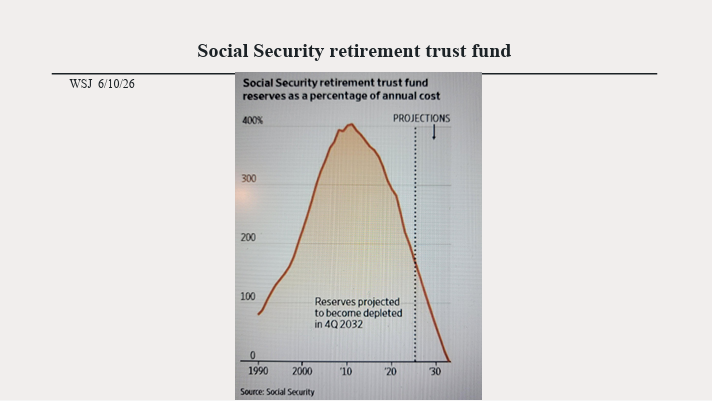
Social Security Shortfall Seen Earlier, in Late 2032.
• Social Security is expected to deplete the fund that helps pay out retirement benefits by late 2032, the program’s trustees said Tuesday.
• That is earlier than their projection last year of 2033, partly because the fund expects to collect less revenue after President Trump’s new tax law.
• Revenues are also shrinking because declining fertility rates and immigration are reducing tax revenue
by cutting the number of workers paying into the system, the trustees said.
Unless Congress shores up the retirement program, the depletion of reserves would trigger a 22% reduction in benefits in late 2032.
• Congress could temporarily use money from the disability trust fund to prop up the retirement fund.
But that is a short-term solution because on a combined basis,
the two funds are projected to become insolvent in the third quarter of 2034, according to the trustees.
Oil Prices Fall, Stocks Climb On Iran Deal
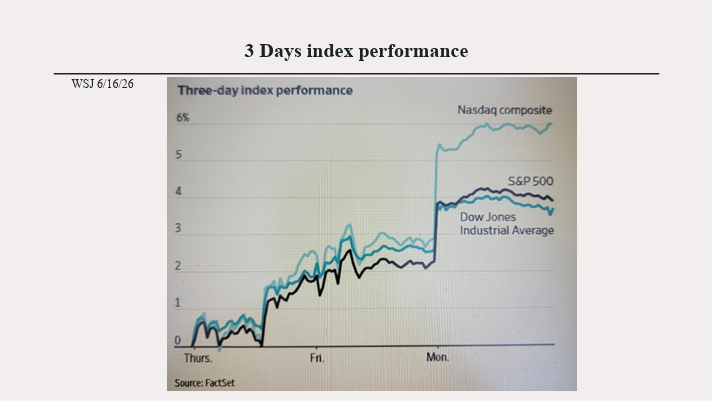
• Oil prices fell, bonds rallied and the Dow Jones Industrial Average closed at a record on Monday
after President Trump announced a deal to end the war with Iran and reopen the Strait of Hormuz,
the world’s most vital artery for energy shipments.
• The latest Middle East developments added to the ledger of optimistic news and capped
the market’s best three-session stretch since the May 2025 tariff de-escalation with China. Wednesday’s readout on lower inflation,
followed by Friday’s blockbuster stock debut by Elon Musk’s SpaceX, had left investors feeling good about stocks heading into the weekend.
• Major oil-importing economies— including Japan, South Korea and the Philippines— led the surge, with major indexes tied to those countries rising 5% or more.
North Korea Economy Becomes World’s Most Unlikely Success.
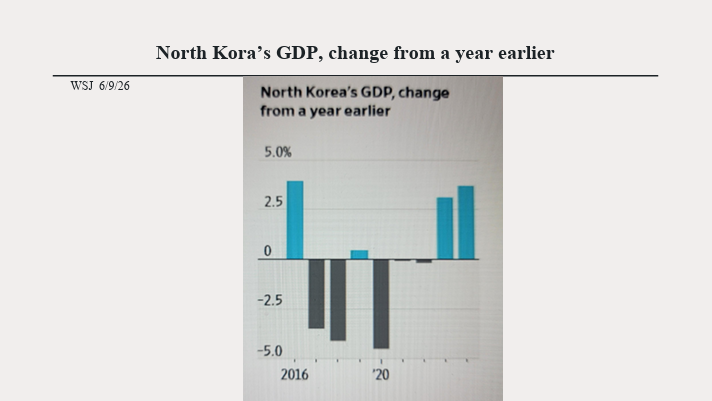
• North Korea is the world’s most unlikely growth story. Its economy is flourishing in ways not seen in years,
aided by arms sales and troop deployments to Russia, supplies and financing from China,
and the ability to flout international sanctions to import more energy, components and materials.
Chinese leader Xi Jinping traveled to North Korea this week for his first foreign trip of the year.
• The economic slump began to reverse after Russia’s February 2022 invasion of Ukraine, which North Korea publicly endorsed.
• More than a year into the war, North Korea became a munitions supplier to Moscow,
generating more than $10 billion from the summer of 2023 to the end of last year, according to INSS,
the think tank—a big boost to an economy with an estimated GDP of about $27 billion. (South Korea’s GDP is 1.93 trillion)
More Americans Want to Age at Home.
• Around three-quarters of Americans over 50 want to age in their current homes, according to AARP.
But many of their homes aren’t suitable for aging because of stairs, bathtubs, narrow doorways and slippery tile floors.
Only about 10% of homes are considered “aging- ready,”
meaning they have a step-free entry and bedroom and accessible full bathroom on the first floor,
according to a 2020 census report.
• Unlike prior generations, boomers are the wealthiest older generation ever.
And there are more services in place to help those who want to age in place,
even if it proves costly and requires planning and thoughtful consideration.
• They have a room upstairs in case they want live-in help.
There will be enough space in their new bedroom for a second bed—a hospital one, if needed.
They have hired landscapers and housekeepers to handle maintenance and upkeep. Several years ago, Garrett bought a robotic lawn mower. It has paid for itself.
Remote Work Appears Here to Stay, Even Over Some Bosses’ Objections.
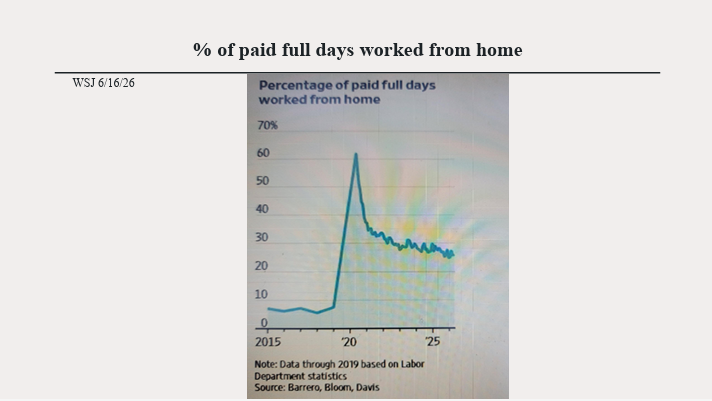
• Work from home is hardly over. In fact, it’s probably here to stay.
• The past couple of years have seen a drumbeat of big companies announcing, to great fanfare, that they were requiring employees to spend more time in the office.
Home Depot, Target, Microsoft, 3M, Intel—the list goes on and on.
• But across the broader economy, the evidence suggests that the return to the office has stalled out.
• An average of 26% of paid, full days were worked from home in May, according to a monthly work-from-home survey run by economists Jose Maria Barrero,
Nicholas Bloom and Steven Davis. That is down, but not by much, from the 27% registered two years earlier.
• It was about 30% in 2022, when companies were transitioning away from the pandemic. But in 2019, before the pandemic struck,
Labor Department figures show that about 7% of days were worked from home.
U.S. Home Prices Surpass $400,000 for the First Time.
• U.S. home prices have exceeded $400,000 for the first time in history,
making homeownership increasingly difficult for many Americans.
• According to the latest report released by real estate brokerage Redfin,
the median sale price of homes nationwide during the four-week period ending June 7 reached $400,894.
This represents a 1.5% increase from a year earlier and marks the first time the national median home price has surpassed the $400,000 threshold.
• At the same time, the financial burden of homeownership remains high.
The average monthly mortgage payment reached approximately $2,860, the highest level recorded since April 2019, which remains near historic highs.
• According to a June 9 report by Business Insider, Lawrence Yun,
Chief Economist of the National Association of Realtors (NAR), stated:
“By 2050, the median sales price of a single-family home in the United States could reach $1 million.”




Join The Discussion