

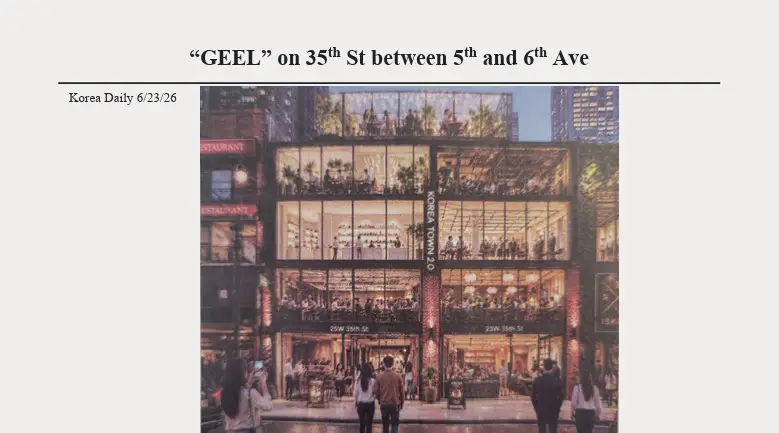
Second Koreatown in Manhattan… ‘35th Geel’ Opens.
• Koreatown, which has grown around Manhattan’s 32nd Street over the past 40 years, is facing a new phase of expansion.
• As the so-called ‘Koreatown 2.0’ project—which integrates Korean brands and K-content—gets underway,
expectations for the creation of a second Koreatown are rising.
• PD Properties (Co-CEOs Tony Park and Jinwoo Park), a real estate development and asset management company,
announced that it is renovating four buildings, including ‘GEEL’,
located in the heart of 35th Street between Manhattan’s 5th and 6th Avenues.
• The core project, ‘GEEL’, involves a full renovation of the 4-story building located at
23-25 West 35th Street into a total of 21,400 square feet across two interconnected wings.
This space, featuring a 4-story building and a rooftop garden,
is currently under construction with the goal of securing a Temporary Certificate of Occupancy (TCO) this coming August.
Florida Condo’s June 2021 Collapse Started Three Weeks Earlier.
• Federal investigators concluded that the catastrophic 2021 partial collapse of the Champlain Towers South condo in Surfside,
FL began roughly three weeks before the building fell.
• In a report released on Monday, the National Institute of Standards and Technology determined that
a structural failure first occurred at two critical garage column connections beneath the pool deck in early June 2021.
• The investigation revealed that the complex’s vulnerabilities stemmed from its original design,
which failed to meet the codes and standards of 40 years ago. The construction itself further deviated from the structure’s design.
• In the weeks leading up to the disaster, the building exhibited physical warning signs that went undiagnosed.
Those included a residential sliding glass door popping out of its frame, shifting entry gates that jammed shut,
and an increase in water leaking through the garage ceiling hours before the final collapse.

U.S. Home Prices Surpass $400,000 for the First Time.
• U.S. home prices have exceeded $400,000 for the first time in history, making homeownership increasingly difficult for many Americans.
• According to the latest report released by real estate brokerage Redfin,
the median sale price of homes nationwide during the four-week period ending June 7 reached $400,894.
This represents a 1.5% increase from a year earlier and marks the first time the national median home price has surpassed the $400,000 threshold.
• At the same time, the financial burden of homeownership remains high.
The average monthly mortgage payment reached approximately $2,860, the highest level recorded since April 2019, which remains near historic highs.
• According to a June 9 report by Business Insider, Lawrence Yun,
Chief Economist of the National Association of Realtors (NAR), stated:
“By 2050, the median sales price of a single-family home in the United States could reach $1 million.”
Cost of Homeownership Continues to Rise .
• For many Americans, the math of homeownership doesn’t add up any more.
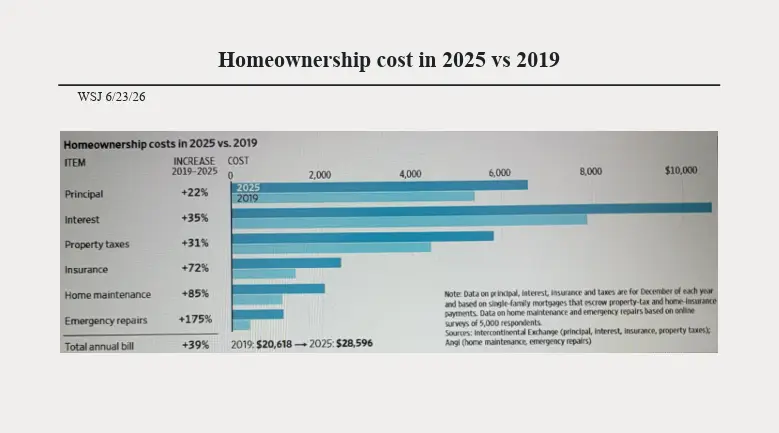
• A home buyer in 2019 could expect to spend about $20,000 a year on basic homeownership expenses:
mortgage payments, property taxes, insurance, maintenance and repairs, industrial stats show.
• By 2025, that annual bill had risen above $28,500, outpacing inflation and keeping many would-be buyers out of the market.
Homeowners who wish they could sell and move elsewhere are staying put, turned off by the cost of purchasing today.
• Sales of previously owned homes have held around 4 million a year since 2023,
the lowest level in decades and down from a pre-pandemic norm of between 5 million and 5.5 million a year, NAR said.
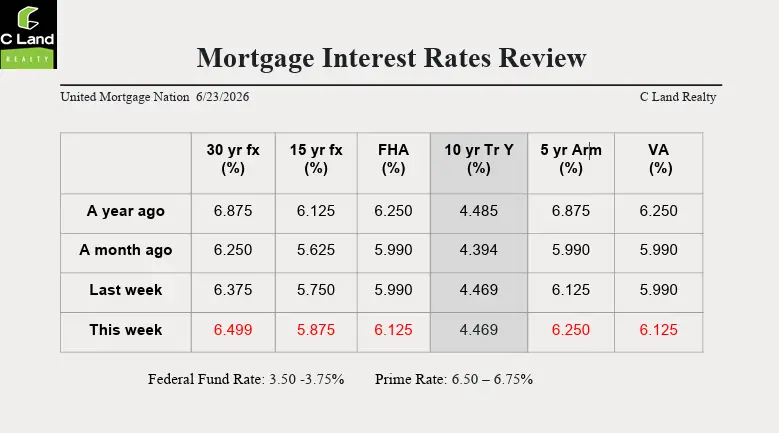
• A buyer with a $2,500 monthly budget and a 20% down payment can afford to buy a $517,500 home at a 3% mortgage rate,
real-estate brokerage Redfin said. At today’s rate around 6.5%, that same buyer can only afford a $384,000.
More Americans Want to Age at Home.
• Around three-quarters of Americans over 50 want to age in their current homes, according to AARP.
But many of their homes aren’t suitable for aging because of stairs, bathtubs, narrow doorways and slippery tile floors.
Only about 10% of homes are considered “aging- ready,”
meaning they have a step-free entry and bedroom and accessible full bathroom on the first floor,
according to a 2020 census report.
• Unlike prior generations, boomers are the wealthiest older generation ever.
And there are more services in place to help those who want to age in place, even if it proves costly and requires planning and thoughtful consideration.
• They have a room upstairs in case they want live-in help. There will be enough space in their new bedroom for a second bed—a hospital one, if needed.
They have hired landscapers and housekeepers to handle maintenance and upkeep.
Several years ago, Garrett bought a robotic lawn mower. It has paid for itself.
Remote Work Appears Here to Stay, Even Over Some Bosses’ Objections.
• Work from home is hardly over. In fact, it’s probably here to stay.
• The past couple of years have seen a drumbeat of big companies announcing, to great fanfare,
that they were requiring employees to spend more time in the office. Home Depot, Target, Microsoft, 3M, Intel—the list goes on and on.
• But across the broader economy, the evidence suggests that the return to the office has stalled out.
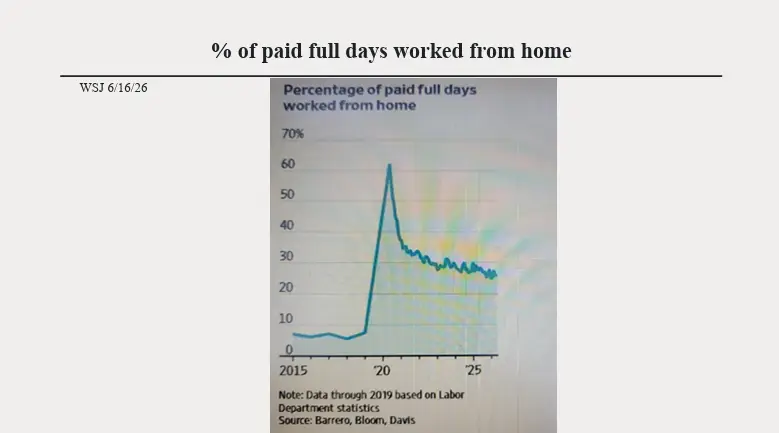
• An average of 26% of paid, full days were worked from home in May,
according to a monthly work-from-home survey run by economists Jose Maria Barrero,
Nicholas Bloom and Steven Davis. That is down, but not by much, from the 27% registered two years earlier.
• It was about 30% in 2022, when companies were transitioning away from the pandemic.
But in 2019, before the pandemic struck, Labor Department figures show that about 7% of days were worked from home.
Fed Holds Interest Rates Steady As Officials Signal an Increase.
• Federal Reserve officials signaled Wednesday that their next move might be to raise interest rates, not cut them,
a striking reversal at Kevin Warsh’s first meeting as chairman and a sign of how sharply the inflation outlook turned.
• The Fed held its benchmark rate steady, in a range of 3.5% to 3.75%, in a unanimous vote.
But officials’ quarterly economic projections told the story of the shift: Nine of 19 officials penciled in at least one rate increase by year’s end, up from none in March.
“We have the capability and commitment to deliver on our price stability objective,” Warsh said. “That’s exactly what we’re going to do.”
• A negotiated end to the Iran war could pull energy and commodity prices back down.
But the deeper problem would remain. A run of disruptions— the pandemic, Russia’s invasion of Ukraine, last year’s tariffs and now the war
—has eroded the Fed’s confidence that underlying inflation will return to the Fed’s 2% goal.




Join The Discussion