

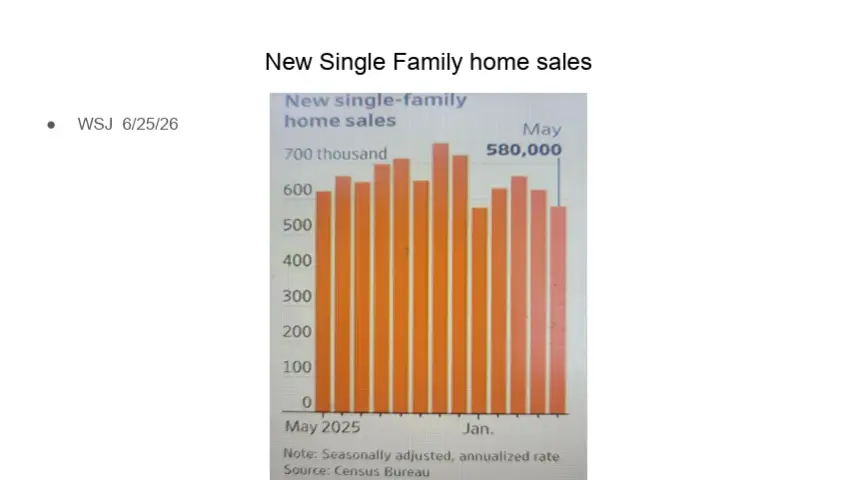
U.S. New Home Sales Fell in May
The rate of new home sales fell in May, according to a report released on
Wednesday by the Census Bureau and the Department of Housing and Urban Development.
Sales of new single-family homes fell to 580,000 in May, from 626,000 in April,
the report said. A consensus of economists polled by The Wall Street Journal
expected 632,000 sales in May.
The estimate for new houses for sale was 496,000 in May,
compared with 485,000 in April, the Commerce Department said.
The median sales price of new houses sold in May was $424,900 up 2% from April, it added.
Home Equity Withdrawals Surge,
with More Homeowners Taking Cash Out.
Total U.S. Home Equity Reaches $11 Trillion. More homeowners are using
rising home values to access cash. About $47 billion was withdrawn in the first
quarter, though variable interest rates require caution.
The median U.S. home price reached approximately $429,300 in May, up
1.3% from a year earlier. Compared with May 2020, when the median price
was about $284,600, home prices have increased by roughly 51%.
HELOC leaves the original mortgage intact while providing a revolving line of
credit secured by the home. Interest rates are usually variable. Current
average HELOC rates are approximately 7.4%.
Unlike a traditional home equity loan, a HELOC allows homeowners to borrow
only what they need, when they need it—similar to using a credit card with the home as collateral.
May PCE Price Index Up 4.1% Year-over-Year ↑
The Personal Consumption Expenditures (PCE) price index in the United
States recorded its highest increase in over three years in May,
driven by the impact of high oil prices resulting from the US-Iran war.
However, outlooks suggest that inflation indicators are highly likely to slow
down in the future, as international oil prices have returned to pre-war levels
following the signing of a US-Iran end-of-war Memorandum of Understanding (MOU).
The Department of Commerce announced on the 25th that the May PCE price
index rose 4.1% compared to the same month last year.
This is the largest increase in 3 years and 1 month, since April 2023 (4.5%).
Compared to the previous month, it rose 0.4%.
Brief Mortgage-Rate Drop Points to False Housing Start
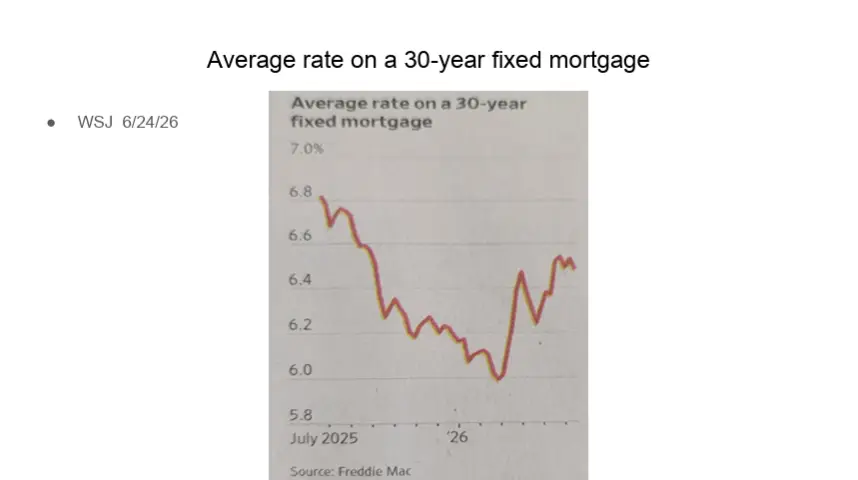
In late February, driven by Fed rate cuts in prior months, the 30-year fixed
mortgage rate drifted below 6% for the first time since 2022.
President Trump lauded the milestone during his State of the Union address, declaring that
lower rates would help solve the nation’s housing problems.
The celebration was short lived. Joint military actions by the U.S. and Israel
against Iran ignited a war that spiked oil prices and stoked inflation expectations.
Treasury yields surged in response, dragging mortgage rates with them.
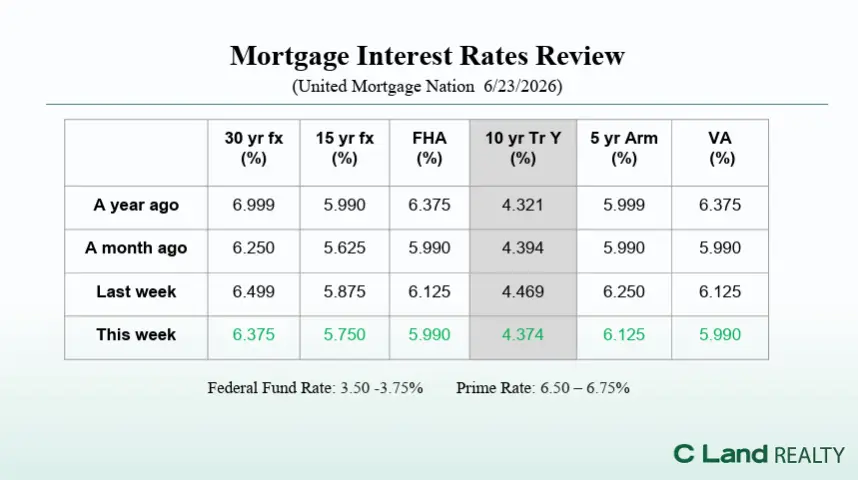
In May, mortgage rates rose above 6.5%.
With the prime spring buying season over and home sales holding at
depressed levels, the market remains frozen by high borrowing costs and
inventory gridlock in many parts of the country. Rising inflation could make
things worse. Consumer prices were up 4.2%, a three-year high, in May, and
Fed officials indicated at a meeting last week that further rate increases are on the table.
ChatGPT and Claude Lean Left, Gemini Neutral
Among the major artificial intelligence (AI) chatbots used worldwide,
most services—including ChatGPT, DeepSeek, and Claude—are biased toward
progressive answers, while only Gemini was found to provide neutral responses, an analysis shows.
On the 24th, The Washington Post (WP) received and published answers to
20 politically sensitive questions in the U.S., including affirmative action for
minorities and birthright citizenship, from major AI chatbot services of tech companies.
The results showed that 80% of ChatGPT’s responses exhibited a progressive stance,
while 70% of DeepSeek’s responses leaned toward progressive content.
Conservative responses stood at a mere 3% and 7%, respectively.
Claude provided progressive answers 43% of the time and neutral answers
57% of the time, with zero instances of conservative responses.
Remote Work Stalls Grads’ Job Prospects
Now, much of Gen Z remains alien to the office. And while executives like
Jamie Dimon and Andy Jassy campaigned to get workers back to their desks,
remote work remains a staple of the workplace, leaving recent grads Zooming into conference calls.
Those workers sometimes struggle to connect with mentors or shadow senior employees.
Training junior workers remotely is “very expensive,” said startup founder Jason Crawford.
“It becomes this silent tax on senior time.”
Crawford’s top employees would be more productive at home, he said, but junior ones aren’t.
Recent grads are already fretting that artificial intelligence is shrinking the junior job market.
Compounding those worries is fresh economic research
arguing that frustration among employers like Crawford over how WFH
policies have played out might have caused them to cut back on hiring young workers altogether.
Fed Quiet Could Mean Mortgage-Rate Rise
At his first news conference as Fed chairman, Kevin Warsh suggested that he wants the market
to tell the Fed what it thinks interest rates should be—and not the other way around.
But when markets are left to their own devices, another upshot could be more
volatility in the bond markets, as traders and investors hash out their divergent
views. And that in turn might mean higher rates as investors demand compensation for the uncertainty.
“Without the Fed as a perceived steady anchor, risk premiums across asset
classes may need to increase.” said Pimco economist Tiffany Wilding.
Any real-estate agent knows that nervous home buyers often need a lot of reassurance.
They, and the broader mortgage market, are about to get less of it.
Trump Derails Housing Bill, Fueling Strains
President Trump abruptly canceled plans to sign bipartisan housing legislation
while again pushing a bill that would impose strict new voter-eligibility rules,
and hours later engaged in a fiery clash with one of his top Republican critics over the Iran war.
The housing bill is a package of more than 50 provisions aimed at making it
easier to build homes and make housing more affordable.
It includes measures speeding up federal environmental reviews for certain housing
projects, removing restrictions on building manufactured homes,
and tying cities’ federal funding to their housing production.
In a series of social-media messages early Wednesday,
Trump canceled plans to sign the bipartisan housing legislation that the House and Senate
passed this week. He said he would refuse to take action on the measure until Congress passes the SAVE America Act.




Join The Discussion