

Paul Kim Defeats Suk Jun Min to Secure Democratic Nomination for Pal Park Mayor
• Paul Kim, the incumbent mayor of Palisades Park, has defeated Pal Park Councilman Suk Jun Min to officially secure
the Democratic nomination for the upcoming Palisades Park mayoral race.
• According to the unofficial tallies released by Bergen County for the New Jersey primary election held on June 2nd,
Mayor Paul Kim clinched 1st place by winning 770 votes (57.9%) out of a total of 1,330 votes cast in the Pal Park mayoral primary.
Councilman Suk Jun Min failed to advance to the general election, receiving 560 votes (42.1%).
• Candidate Justin Kang, who ran on Mayor Kim’s slate,
took 1st place with 705 votes (28.7%) out of 2,459 total votes cast. Candidate Lucy Yang followed in 2nd place with 619 votes (25.2%).
On the other hand, current Councilman Yu-Bong Won, backed by candidate Suk Jun Min,
remained in 3rd place with 603 votes (24.5%), trailing Yang by a mere 16 votes. Candidate Jason Juliano came in 4th with 532 votes (21.7%).
38-Fold Difference in Net Worth Based on Homeownership
• Data shows a stark contrast in wealth accumulation depending on homeownership.
According to a recent analysis by real estate media outlet Realtor.com, based on the Federal Reserve’s Survey of Consumer Finances,
the net worth gap between homeowners and renters reached a staggering 38-fold as of 2022.
• According to the study, purchasing a home before the age of 32 increases net worth by approximately 22.5% by age 50.
Conversely, this gap narrows sharply the later one purchases a home.
• Meanwhile, from a realistic standpoint, buying a home is becoming increasingly difficult.
Over the past 30 years, the rate of home price growth has outpaced wage growth, significantly increasing the ratio of home prices to income.
Furthermore, the supply of affordable housing accessible to first-time homebuyers is on the decline.
Growing Home-Insurance Risk: Claims that Don’t get a payout.
• When disaster strikes, many Americans face a near flip-of-the-coin chance that their home insurer will pay a claim.
• And the problem is getting worse.
The five biggest home insurers as a group didn’t pay out on more than 44% of claims resolved last year,
forcing homeowners and renters to fund repairs out of their own pockets, an analysis by WSJ found.
The risk that a claim will result in no payment among the group—State Farm, Allstate,
Liberty Mutual, United Services Automobile Association and Farmers Insurance— shot up from 36% a decade earlier, according to the analysis.
• Several factors are driving nonpayment rates higher, according to industry analysts and executives.
Prime among them: Insurers are responding to a yearslong run of post pandemic losses in their home-insurance businesses by getting tougher on claims.
Housing Chief Tapped for Intelligence Role.
• President Trump said Tuesday he was appointing Bill Pulte,
a close ally who leads the Federal Housing Finance Agency and
who urged investigations into the president’s perceived enemies, as acting director of national intelligence.
• Pulte will succeed Tulsi Gabbard, who resigned last month, until the president nominates a permanent successor.
Trump in a social-media post said that Pulte “has deep experience managing the most sensitive matters in America,”
citing his having taken over as the chairman of mortgage finance giants Fannie Mae and Freddie Mac early last year.
• Sen. Mark Warner, the top Democrat on the Intelligence Committee,
said Pulte “appears to have been selected precisely because the White House believes he will provide the narrative it wants,
not the intelligence we need.”
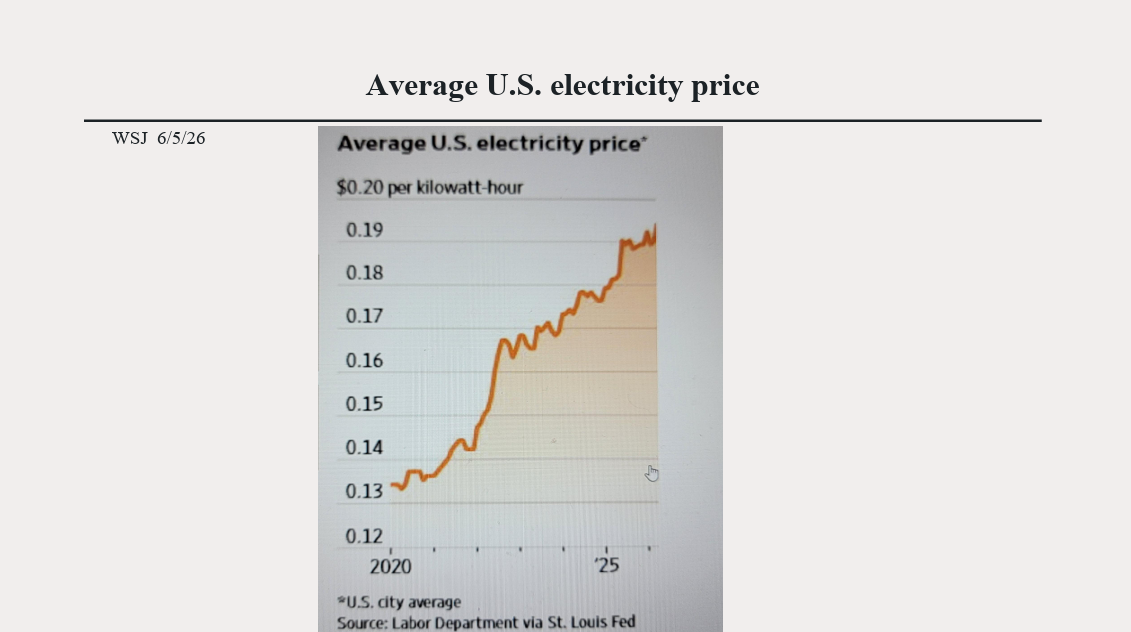
Battles Grow Over Who Will Pay For Rising Costs of AI Power Needs.
• A new style of architecture is rising in the sprawling suburbs of the Sonoran Desert:
windowless data centers that hum 24 hours a day and guzzle as much electricity as a midsize city.
• Arizona Public Service, the state’s largest utility, is at the center of the firestorm.
APS is proposing a 45% electricity-rate increase for “extra-large energy users,” primarily data centers,
and a roughly 14.5% increase for residential customers. Nearly everyone is unhappy.
• Arizona Attorney General Kris Mayes, a Democrat and former utility commissioner,
wants to see data centers carry a heavier share of the burden.
Even a 45% rate increase won’t fully cover the costs to plug them in, she said, while arguing residential customers should see about a 3% hike.
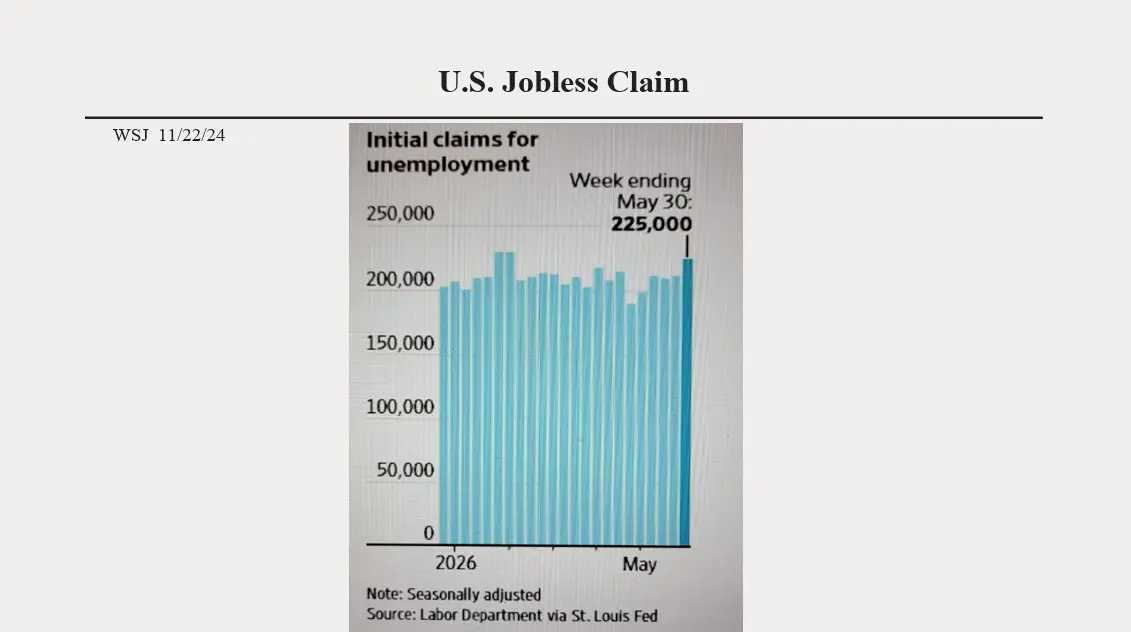
Jobless Claims Rose in Week.
• U.S. jobless claims rose last week, but the level was still within a range consistent with a healthy labor market.
• The number of people who filed for unemployment benefits rose to 225,000 in the week through May 30,
higher than the 212,000 reported a week earlier, the Labor Department said Thursday.
Economists surveyed by The Wall Street Journal were expecting to see 215,000 new claims.
• Continuing claims stood at 1.78 million in the week through May 23, versus a revised 1.79 million a week earlier.
Berkshire Keeps Faith In Home Building.
• Berkshire Hathaway’s $6.8 billion deal to acquire a major home builder reflects its conviction
that the housing market will shake off its yearslong slump and recover as it always has.
• With an all-cash agreement Sunday for this deal, the Omaha, Neb.
based conglomerate is poised to become a top-five U.S. home builder, adding to its growing portfolio of housing related companies.
It owns companies across the housing supply chain, from manufactured-housing firm Clayton Homes to real-estate brokerage service HomeServices of America.
Over the past several years, Berkshire has held stakes in other large public builders, such as D.R. Horton and Lennar.
• Berkshire’s home-builder deal is a sign that it wants to be positioned to take advantage of any market turn.
More than 75% of young renters still think they someday will own a home, according to a survey by John Burns Research & Consulting.




Join The Discussion