

Homeownership Timing,
Asset Accumulation, and the Racial Wealth Gap
Wealth and White-Black Wealth Gaps
Wealth consists of the assets a household accumulates over time,
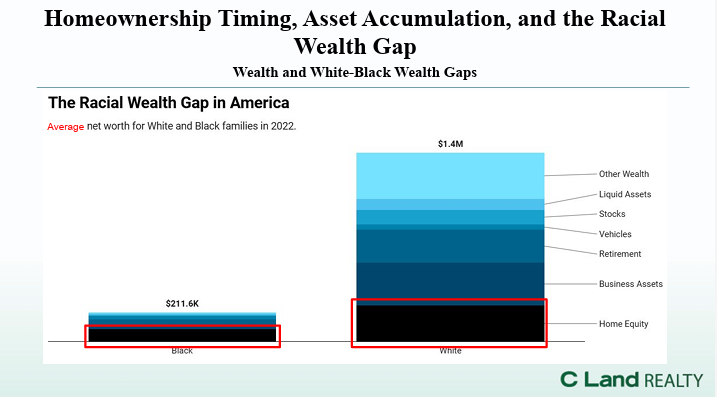
and home equity is the largest portion of household wealth
across most of the U.S. wealth distribution
Wealth Accumulation & Equity Growth:
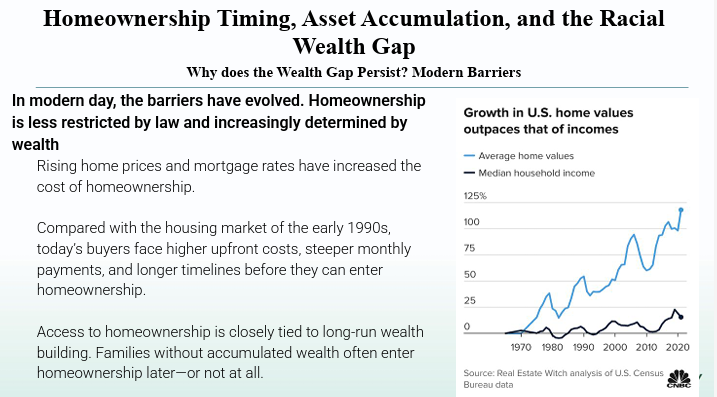
Real house prices in the U.S. have risen by roughly
150% over the last 6 decades (Madison Trust)
Housing appreciation explains roughly 70%
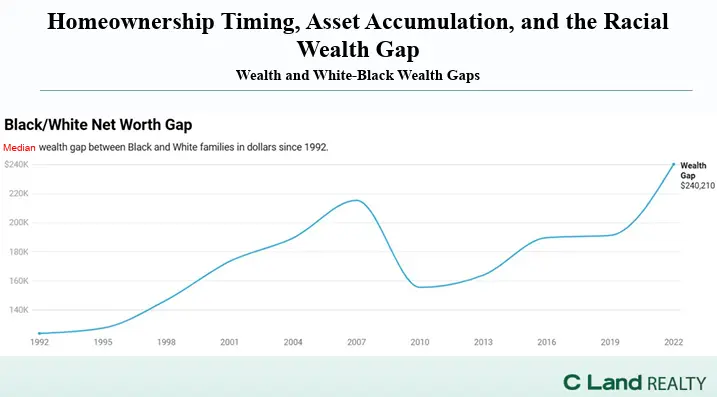
of the increase in the median Black-White wealth gap since 1984. (LaBriola)
However, access to homeownership and housing wealth
has not been equal across racial groups.
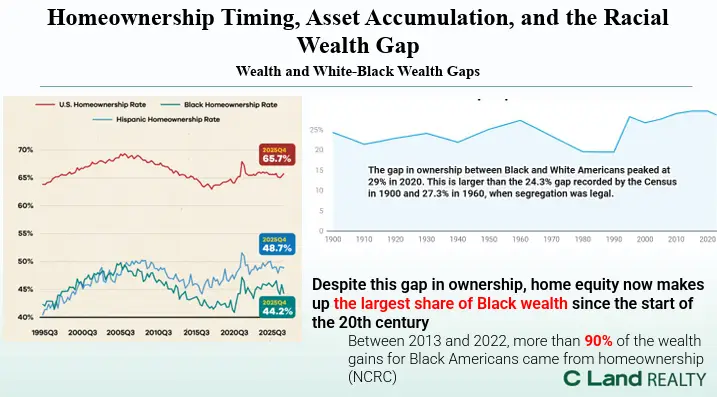
White households are both more likely to own homes, as well as more expensive homes.
As of 2021, the median non-Hispanic Black household had 6% as much wealth as the
median non-Hispanic White household ($12,000 vs. $181,194) (PSID)
Housing outcomes today were influenced by historical policies and practices including
Redlining
Residential segregation
Discriminatory mortgage lending
Unequal access to credit
which reduced opportunities for many Black families to purchase and retain homes.
Due to discrimination, many non-white households were excluded from
the post-WWII expansion in homeownership
The U.S. homeownership rate increased by 20% between 1940 and 1960, but this rapid
expansion was not spread evenly—it was concentrated among white, higher-income families.
Wealth is cumulative
Two households with similar incomes can end up with vastly different wealth depending on
whether—and when—they own appreciating assets.
So, a small ownership gap today can become a large wealth gap decades later,
resulting in the stark difference in Black vs. White household’s net worths.
Furthermore, accumulated housing wealth doesn’t just shape
a household’s financial security, but also the next generation’s.
Children of homeowners are more likely to become homeowners themselves.
This creates a cycle in which housing wealth is continually reinforced within families.
Potential Solutions
● Promote long-term asset building through initiatives such as baby bonds,
community land trusts, and homeownership education.
● Increase housing affordability by expanding housing supply and
supporting affordable housing development
○ Relevant at the moment: 21st Century Road to Housing Act
● Address historical disparities through reparations or policies aimed at reducing wealth and
homeownership gaps across generations.
Takeaways
● Housing is the primary wealth-building asset for most American families.
● Timing matters—earlier homeownership allows more time for appreciation, equity growth,
and intergenerational wealth transfer.
● The racial wealth gap has been shaped by historical housing policies
that bolstered differences in homeownership and home equity.
● Closing the gap requires expanding access to affordable homeownership
and long-term wealth-building opportunities.




Join The Discussion