
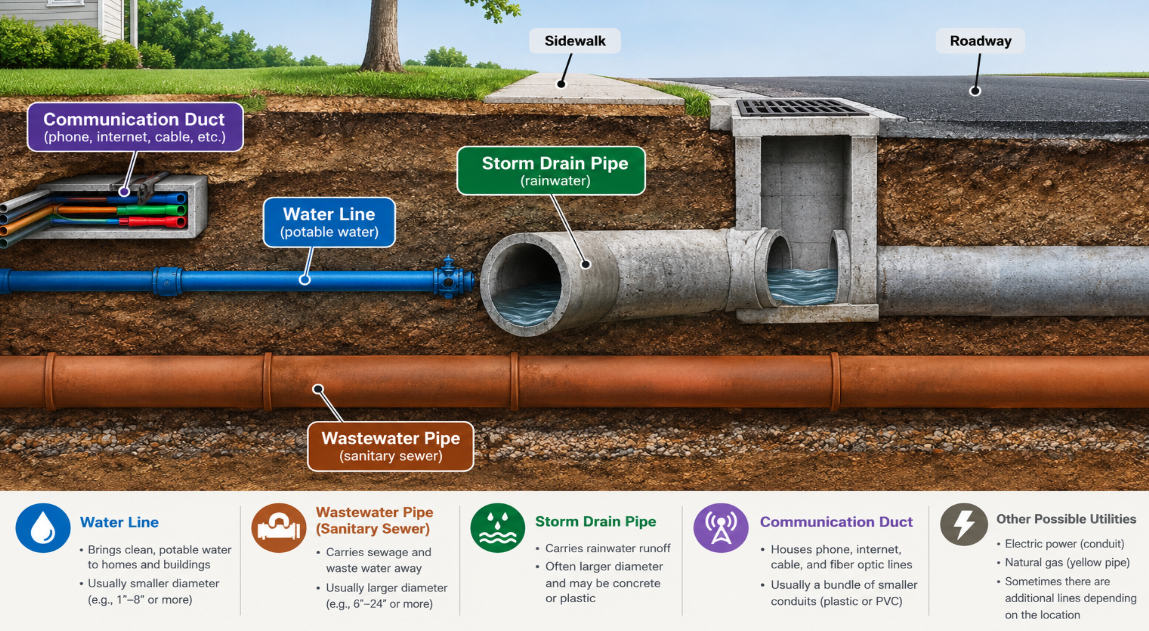
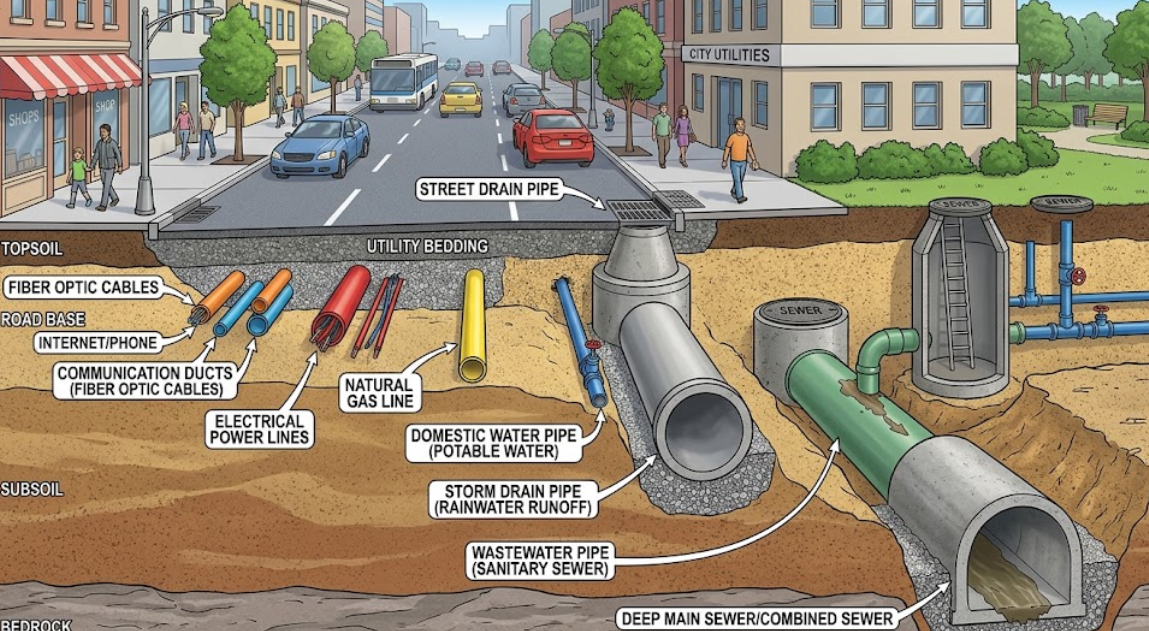
Where two drain system ends up?
Storm Drain Pipe
Purpose: Quickly drains rainwater and melted snow to prevent urban flooding.
Final Destination: Discharges directly into natural bodies of water (rivers, lakes, streams, or the ocean)
without going through a treatment process.
Key Feature: Because the water is not treated, debris, litter, or oil washed off streets can directly pollute the environment.
Wastewater Pipe / Sanitary Sewer
Purpose: Carries away wastewater generated from homes, businesses, and industrial facilities (e.g., toilets, sinks, showers).
Final Destination: Flows to a Wastewater Treatment Plant.
Key Feature: The wastewater undergoes physical and biological treatment to be purified
before being safely released into rivers/oceans or reused.
(Note: Some older city systems use combined sewer systems
where rainwater and wastewater flow together during heavy storms.
However, modern urban infrastructure predominantly uses
separate sewer systems to prevent environmental pollution.)
CSS(Combined Sewer System) and sewer backflow
Like many older towns and municipalities across New Jersey,
portions of Palisades Park still rely on combined sewer infrastructure constructed in the early-to-mid 20th century.
1. How a Combined Sewer System (CSS) Works
Normal Conditions: Under dry or light-rain conditions,
both domestic/commercial wastewater
(from toilets and sinks) and surface runoff (rainwater) share the same underground pipes.
They flow together to a regional treatment facility (such as the Bergen County Utilities Authority / BCUA) to be purified.
Heavy Rainfall: During sudden downpours or severe storms,
the massive volume of rainwater draining from streets rapidly exceeds the maximum capacity of the sewer mains.
2.Why Backflow Occurs in Toilets and Sinks
When the main sewer line reaches full capacity, water levels and hydraulic pressure spike inside the pipe.
Unable to flow downstream fast enough,
the mixture of rainwater and sewage pushes backward toward the path of least resistance.
This excess water gets forced upward through lateral connections into
lower-lying drains—such as basement fixtures,
ground-floor toilets, and lower-level sinks in local businesses.
This backflow happens when a building lacks a functional backwater valve (check valve)
on its main sewer lateral, or when the pressure overcomes older plumbing fittings.
3. Solutions and Prevention
Installing a Backwater Valve:
Property owners can install a one-way backwater valve (check valve) on their main drain line.
When water pressure reverses from the city main, the valve automatically shuts,
preventing sewage from backing up into the building.
Infrastructure Upgrades: The New Jersey Department of Environmental Protection (NJDEP)
and regional utility authorities are actively pushing for sewer separation projects
(converting to separate storm and sanitary lines) and long-term control plans.
However, because these projects require extensive street excavation and immense capital funding,
they are carried out in gradual phases over many years.
Other towns with CSS in Bergen County
There are several other towns in Bergen County (and immediately adjacent areas)
that experience similar issues with Combined Sewer Systems (CSS) and backflow during heavy downpours.
Because much of this region developed in the early-to-mid 20th century,
several municipalities under or connected to regional utilities like
the Bergen County Utilities Authority (BCUA) share these infrastructure challenges:
1. Fort Lee
Context: Located right next to Palisades Park, parts of Fort Lee—
particularly around and south of Main Street—utilize combined sewer infrastructure.
Issues: During intense storms, rapid hydraulic pressure buildup in the mains frequently
causes sewage and stormwater to back up into basements and ground-floor commercial properties.
2. Hackensack
Context: As the county seat of Bergen County,
Hackensack relies on legacy sewer infrastructure built in the early 1900s.
Issues: Low-lying commercial and residential zones near
the Hackensack River have historically suffered from basement backflow and street flooding
when rainwater overwhelms the capacity of the combined system.
3. Ridgefield Park
Context: Neighboring Palisades Park and Ridgefield, Ridgefield Park also
operates sections of combined sewers that channel flow toward BCUA facilities.
Issues: High-volume rain events cause water levels inside the mains to spike,
leading to drain backups in buildings and Combined Sewer Overflows (CSOs).
4. North Bergen (Adjacent Hudson County)
Context: Directly bordering southern Bergen County,
North Bergen relies heavily on a large combined sewer network.
Issues: Due to the steep local topography,
heavy runoff rushes rapidly down hillsides into lower-elevation main lines,
causing significant backflow into toilets, sinks, and drains in lower-lying properties.
Solutions & Local Status
Most of these municipalities are subject to Long Term Control Plans (LTCPs) mandated by
the New Jersey Department of Environmental Protection (NJDEP) to separate storm and sanitary sewers over time.
However, because full utility separation requires extensive street excavation and decades of capital investment,
installation of a backwater valve (check valve) on the main lateral line remains
the most immediate and reliable line of defense for individual property owners in these areas.




Join The Discussion